
The Funeral of ExEcuted King, Charles I
The fact that Charles I received a burial at all, let alone one at the royal residence of Windsor, was both lucky and unlikely.
Charles was a shy, uncharismatic man who had made a disastrous king.
Charles I was b-headed on 30th January 1649, outside the Banqueting House in Whitehall.
His embalmed body was put into a coffin and taken to St James’.
To appease the many English citizens who were shocked by the exEcution of their king, Parliament agreed to bury Charles in the Chapel of St George, at Windsor.
Some reports say that the King’s head was reattached to his body on the great table in the Deanery at Windsor, where the coffin rested briefly after its arrival at Windsor Castle.
Evidence to support this claim, is scant.
Mr Herbert, who had been a groom of the royal bedchamber, was entrusted with overseeing the interment.
On 8th February, the body of King Charles I, his coffin being covered with a black velvet pall, was brought from his bedchamber down into the Dean’s Hall.
He remained her overnight.
On the evening of 9th February 1649, the body of Charles I was taken to St George’s Chapel.
It was a cold snowy day and his coffin was carried by the Duke of Richmond, the Marquis of Hertford and the Earls of Southampton and Lindsey.
The snow fell so fast that by the time the coffin came to the West end of the Royal chapel, the black velvet pall was all white (the colour of innocence), being thick covered with snow.
The king’s body was then lowered into the vault which holds the bodies of King Henry VIII and Jane Seymour,
without any words, or other ceremony.
Years later the royal family had ‘lost track’ of Charles’ body.
Some thought that his son Charles II may have reburied his body at Westminster Abbey.
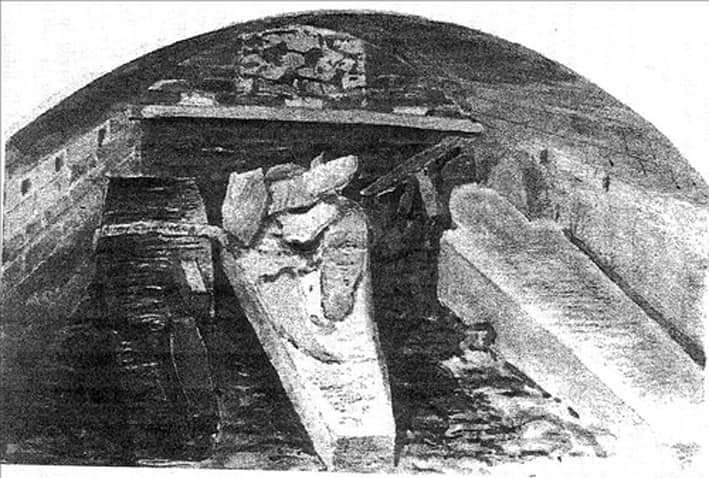
When construction of a mausoleum at St. George’s Chapel began under George III in 1813, workmen accidentally made an opening in one of the walls of the vault where Henry VIII and Jane Seymour were said to be buried.
Two more coffins could also be seen.
The third coffin was covered with a black velvet pall.
The head of the skeleton within, was severed from the body.
It was undoubtedly Charles.
There was also a very small mahogany coffin covered with crimson velvet laid upon the pall covering King Charles.
This contained a child of Queen Anne, still-born when she was Princess of Denmark.
The Prince Regent was told of the discovery and he sanctioned an examination of the coffin.
This took place on 1st April 1813.
The Prince Regent entered the vault accompanied by the Duke of Cumberland, Count Munster, the Dean of Windsor, Benjamin Charles Stevenson, and Sir Henry Halford.
The black velvet pall was removed to reveal a plain lead coffin inscribed with the name of King Charles and the year of his death.
An opening was then made in the lid and the covering removed from the head.
Sir Henry reported that the long oval- shaped face with a pointed beard bore a strong resemblance to coins, busts, and the Van Dyck pictures of Charles I.
The head was removed from the coffin to prove that it had been separated ‘by a heavy blow, inflicted with a very sharp instrument’, proving beyond doubt that these were indeed the remains of King Charles.
The rest of the body was not examined and the coffin was soldered up.
Here our story would finish were it not for another partial opening of the vault on the 13th December 1888… and the curious reason this took place.
It appears that in 1813 the Royal Physician, Sir Henry Halford, took with or without permission certain “relics” from the body of King Charles I.
This included the fourth vertebra, which bore the marks of the axe, as well as a tooth and a portion of his beard.
Halford claimed that after the coffin had been closed three items were not replaced.
The Prince Regent said that it was not worth re‐opening the coffin, and handed them to Halford.
In 1888, the ‘relics’ in question were finally given to the Prince of Wales by a grandson of Sir Henry Halford.
The Prince duly advised the Dean of St. George’s Chapel that, having obtained permission from his mother Queen Victoria, he desired to return these artefacts to the vault.
At 6 pm on the 13th December 1888, Dean Davidson, superintended the removal of the inscribed pavement stone above the vault, and six of the black and white marble squares.
The Prince of Wales arrived just after 7pm and performed the task of lowering the box of relics, placing it about the centre of the coffin of King Charles I.
The Prince then departed and the closing up of the vault immediately commenced.
All was conducted with the utmost decorum, dignity and reverence.
Another artefact still exists in the Royal Collection which relates to the 1813 exhumation.
A beautiful gold and enamel locket apparently given by George to his daughter Princess Charlotte.
An inscription confirms that it contains the hair of King Charles I, having been removed from his head in 1813.
Since 1813 the remains of the stillborn child, King Charles I, King Henry VIII, and of his Queen Jane Seymour, have remained undisturbed.
May they all now rest in peace for eternity.
About The Author


