
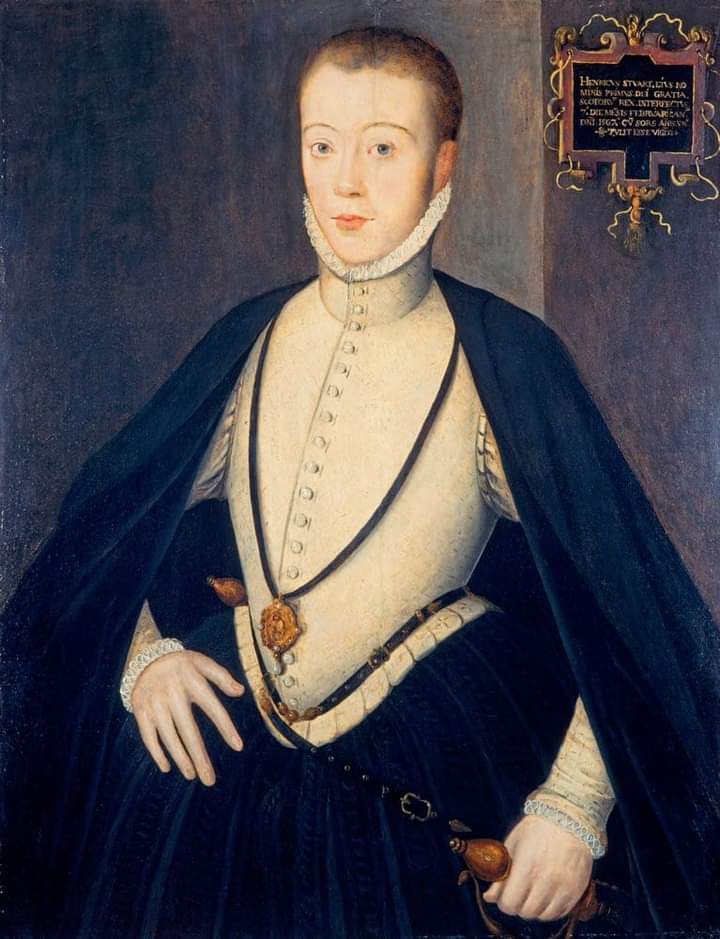
Death of Henry Stuart Lord Darnley ~ Consort of Mary Queen of Scots
Henry Stuart ~ Lord Darnley, was born at Temple Newsham in Yorkshire on 7th December 1545.
He was the eldest son of Matthew Stewart, Earl of Lennox and Lady Margaret Douglas.
Through his mother, he was a great-grandson of English King Henry VII.
Darnley and his future wife Mary Queen of Scots, also shared a grandmother, Margaret Tudor.
This placed him close to the succession to the Crown of England, after Queen Elizabeth I.
He was also, via his father, a descendant of a daughter of James II of Scotland, this placed him distantly in line for the throne of Scotland.
Darnley’s mother was determined that her son should marry Mary Queen of Scots.
After the death of Mary’s first husband Francis II in 1560, Darnley was sent to France by his mother – apparently with a view to him meeting the newly widowed Mary.
Although the two met, nothing came of it.
It was only after Darnley, now aged 19, travelled to Scotland with his father in February 1565, that he and Mary grew closer.
In April 1565 Darnley fell ill with measles at Stirling Castle, and it was Mary who nursed him back to health.
By the time he had recovered, Mary had fallen in love with this exceptionally attractive and tall young man.
The marriage took place on 29th July 1565, in the chapel of the Palace of Holyroodhouse in Edinburgh.
Most of Mary’s advisors were against the match from the start.
Queen Elizabeth of England also publicly came out against the marriage, ordering Darnley and his father to return to England before it took place.
Mary’s haste to marry Darnley was such, that she did not even seek the required dispensation from the Pope.
Because of her blood relationship with Darnley, a dispensation should have been applied for.
The marriage went smoothly for about as long as it took Mary to conceive, in the Autumn of 1565.
But Darnley soon made it clear he was dissatisfied with the title of King Consort, when he felt he should be a King of Scots with full regal authority.
It soon became clear to everyone, that Darnley was a dim, immature, dissolute and thoroughly nasty young man.
Matters came to a head in March 1566, when Darnley was persuaded to take part in a coup against Mary by a number of Lords she was planning to have tried for treason.
The first step in the plot was the murder of her Private Secretary David Rizzo, on 9th March 1566.
This happened right in front of a pregnant and distressed Mary.
On 19th June 1566, Mary gave birth to a son.
The future James VI of Scotland and I of England.
Mary made very sure that Darnley publicly acknowledged that the child was his, but Darnley refused to attend the Christening at Stirling Castle later that year.
At the beginning of the year 1567, Darnley fell ill in Glasgow – probably from syphilis picked up during one of his many forays into the seedier side of Scotland’s cities.
Mary went to see him, and returned with him to Edinburgh.
Here, Darnley was lodged in the Provost House attached to a church called Kirk O’Field, just inside the city walls.
On 9th February 1567, Mary visited Darnley in the evening, before returning to the Palace of Holyroodhouse.
In the early hours of the following morning, the house Darnley was staying in was destroyed by a huge explosion.
Darnley and his manservant were found dead in the orchard behind the house, apparently having been strangled while trying to escape the blast.
Darnley was dressed only in his nightshirt, suggesting he had fled in some haste from his bedchamber.
Public opinion at the time, was pretty sure that the murderer was James Hepburn~ 4th Earl of bothwell.
Bothwell faced a sham trial for the murder, and was acquitted.
But for Mary, the murder was the beginning of the end.
By marrying Darnley, she had lost most of her political support in Scotland.
By then, apparently, helping murder him, she lost most of her public support.
Soon after Darnley’s death, Bothwell and Mary left Edinburgh together.
There are two points of view about the circumstances – in the first, Bothwell kidnapped the queen, took her to Dunbar Castle, and r@ped her.
In the second, Mary went with Bothwell willingly.
The story of r@pe was a fabrication, so her honour and reputation were not ruined by her marriage to a man widely suspected of murder.
Mary later miscarried twins by Bothwell while a prisoner at Lochleven Castle.
Mary then went on to marry Bothwell – the country turned against her and she was rapidly deposed from power.
Darnley was buried in the Royal vault in Holyrood Abbey, in 1567.
In 1668, the vault was opened by mobs, and sometime later (between 1776 and 1778), the vault was raided and the skull of Lord Darnley was stolen.
? Lord Darnley in his late teens c.1564
By an unknown artist.
National Galleries of Scotland.
About The Author


