
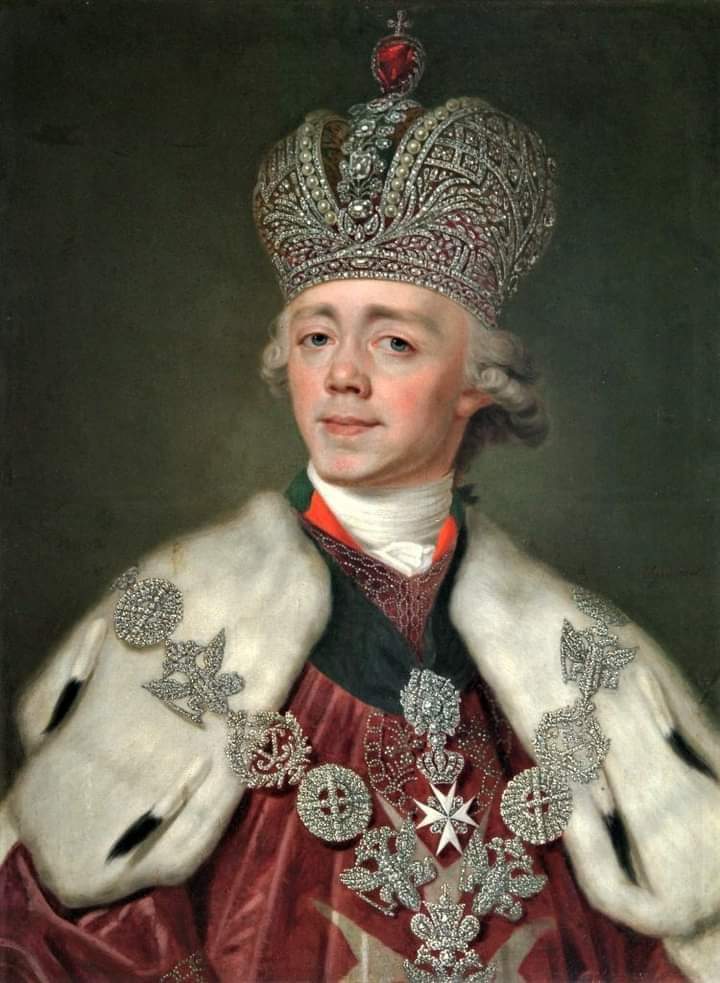
Portrait of the Emperor Paul I of Russia', (1754-1801), 1799-1800. Borovikovsky, Vladimir Lukich (1757-1825). Found in the collection of the Museum of Fine Arts Academy, St. Petersburg. (Photo by Fine Art Images/Heritage Images/Getty Images)
The assassination of Tsar Paul I of Russia
Paul I of Russia, was the son and successor of Catherine the Great, who took the Romanov throne away from her feeble-minded husband, Tsar Peter III.
Paul was born on 1st October 1754 in Saint Petersburg.
Catherine had hinted that her lover Sergei Saltykov was Paul’s biological father, she later recanted, saying that Peter III was Paul’s true father.
In spite the doubts of his legitimacy, he greatly resembled his father Peter III, and other Romanovs as well, and shared the same character.
The formidable Catherine had little time for her son and heir.
Paul was taken almost immediately after birth by his great- aunt, the Empress Elizabeth.
From then on, he had limited contact with his mother.
As a boy, he was reported to be intelligent and good-looking, but sickly.
In 1772, Paul, turned eighteen.
In a bid to keep her son away from her throne, Catherine married him off to a minor German princess, Princess Wilhelmina of Hesse-Darmstadt, who acquired the Russian name Natalia Alexeievna.
Catherine settled them on an estate at Gatchina, away from the centre of affairs at St Petersburg.
Here Paul could play at soldiers and hold the meaningless military parades in which he loved.
Sadly, Wilhelmina and their child died in childbirth on 15 April 1776, three years after the wedding.
Less than six months after the death of his first wife and their child, Paul married again.
The bride was the beautiful Sophia Dorothea of Württemberg, who received the new Orthodox name Maria Feodorovna.
Paul and his wife had a son Alexander, born in 1777.
Catherine had Alexander brought up at her court.
As the empress neared her death, it seemed that she might name her grandson Alexander, not Paul, as her successor.
However, when Catherine died in November 1796, her son Paul succeeded at the age of forty-two.
Tsar Paul set about reversing many of his mother’s policies, and weakening the influence of the aristocracy.
He tried to lighten the burden on the serfs, at the expense of the landowners, and appointed bureaucrats to run central and local government.
Paul forbade his subjects to travel abroad, and banned the import of foreign books.
His foreign policy was a disaster and his outbursts of ungovernable rage, gave his opponents grounds to question his sanity.
Paul also ordered the bones of Grigori Potemkin, the famed military commander and one of his mother’s lovers, dug out of his grave and scattered.
Paul’s premonitions of assassination were well-founded.
His attempts to force the nobility to adopt a code of chivalry, alienated many of his trusted advisors.
On a cold Monday night in St Petersburg, Paul hosted a dinner party at the palace.
Those present included his son, the Grand Duke Alexander.
Alexander ate little, and seemed ill at ease.
After dinner the Tsar retired to his private apartments.
There are conflicting accounts of what happened later, but a group of conspirators led by General Leo Bennigsen and Count von Pahlen, the military commander of the city, were quietly admitted to the palace.
Von Pahlen went to Alexander’s rooms, while Bennigsen led a party of guards officers to the Tsar’s suite.
The conspirators had mostly had a good deal to drink.
They overpowered two valets, broke down the door and went into the bedroom, which was lit by a single candle and seemed empty.
Paul was soon found cowering in terror behind a screen.
The conspirators pulled him out, forced him to the table, and tried to compel him to sign his abdication.
Paul offered some resistance, and was struck with a sword, after which the assassins strangled him with a scarf, then trampled him to death.
It was shortly before one o’clock in the morning of the 23rd March 1801.
Paul’s successor on the Russian throne, his 23-year-old son Alexander, was actually in the palace at the time of the killing.
He had certainly given his consent to the overthrow of Paul, but had not supposed that this would be carried out by means of assassination
It was said, he had a guilty conscience for the rest of his life…..
? Emperor Paul I of Russia by Vladimir Borovikovsky c1800
About The Author


