
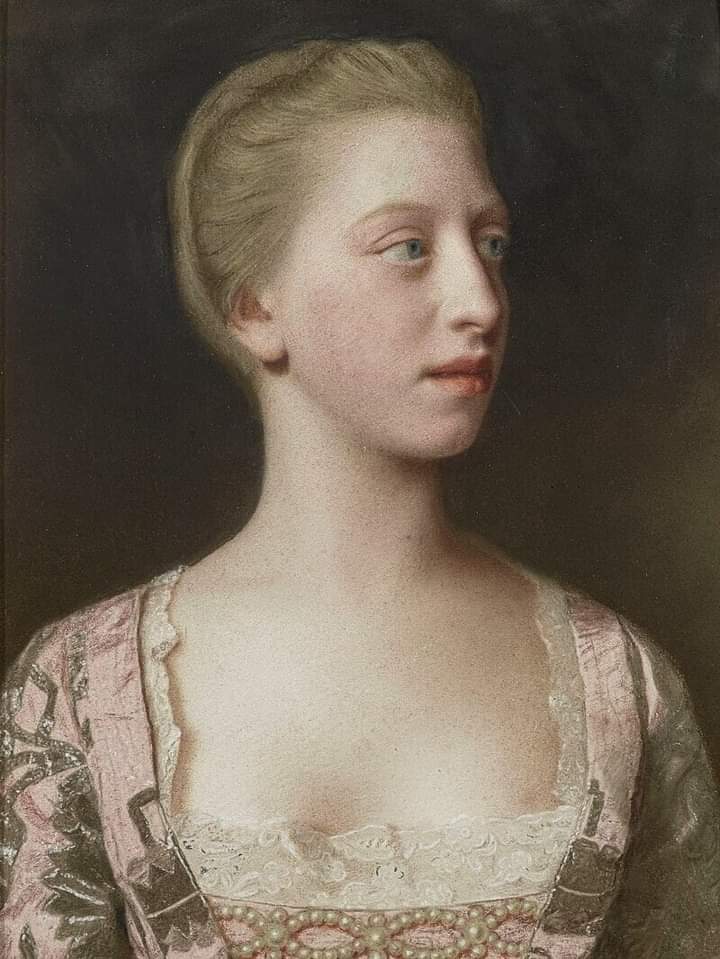
Death of Princess Augusta Frederica of Great Britain, later Duchess of Brunswick
Princess Augusta Frederica was a British princess, grandaughter of George II and the only elder sibling of George III.
Princess Augusta Frederica was born at St. James’s Palace, London on 31st July 1737.
Her father was Frederick, Prince of Wales, the eldest son of King George II and her mother was the Princess of Wales, Augusta of Saxe-Gotha.
The young princess Augusta’s third birthday was celebrated by the first public performance of ‘Rule, Britannia!’ at Cliveden in Buckinghamshire.
As Augusta was born second in the line of succession, she was given a careful education.
She was not described as a rare beauty, having a loose mouth and long face.
The arrival of her younger brother, the future George III, pushed Augusta out of the line of succession.
Negotiations for a suitable marriage began in 1761.
On 16th January 1764, Augusta married Charles William Ferdinand, Duke of Brunswick-Wolfenbüttel, at the Chapel Royal of St James’ Palace.
Augusta never fully adapted to life in Brunswick. She always viewed Great Britain in very high regard.
Augusta regarded her residence in Brunswick as too simple, and unrefined for her royal tastes.
In 1764, Augusta returned to London to give birth to her child.
It took a long time for Augusta to agree to returning to Brunswick after the birth.
During their visit in England, Augusta and her husband were cheered by the crowds, whenever they showed themselves in public.
This, reportedly, made them exposed to suspicion in the eyes of the court.
During their visit, her sister-in-law queen Charlotte apparently refused them some honours at court.
The queens rubuttal attracted negative publicity toward the royal couple.
Seeing their popularity wane, Augusta aggred to go back to Brunswick.
A new palace was built for Augusta in Zuckerberg, south of Brunswick.
It was built more to her taste, and called Schloss Richmond, to remind her of England.
When the palace was finished in 1768, Augusta moved there permanently.
Augusta thought Charles very handsome, and was initially pleased with him.
However, by this time their marriage was starting to become strained.
They came to regard each other with mutual indifference.
Augusta was indifferent to Charles’ affairs, however, her indifference was seen as arrogance, and it gave rise to rumours and slander.
Augusta’s popularity was severely damaged by the fact that her eldest sons were born with handicaps.
In 1772, Augusta visited England to see her mother. On this occasion, she was once again involved in a conflict with her sister-in-law, queen Charlotte.
She was not allowed to live at Carlton House or St.James Palace despite the fact that it was empty at the time, but was forced to live in a small house at Pall Mall.
The queen had a conflict with Augusta about etiquette, and refused to let Augusta see her brother the king, alone.
When Charles became regent in 1773, Augusta filled the position of first lady in the court ceremonies of Brunswick.
In 1780, Charles, already regent for his father, became sovereign duke, and Augusta became duchess consort.
In 1806, Prussia declared war on France.
Augusta’s husband Charles, 71 at the time, was appointed commander-in-chief of the Prussian army.
Napoleon defeated the Prussian army, at the battle of Auerstadt.
Charles was seriously wounded.
Augusta, with two of her sons, and a widowed daughter-in-law, fled her ruined palace for Altona, to be at her dying husband’s side.
Due to the advancing French army, Augusta was advised by the British ambassador to flee, and she left shortly before her husband’s death.
Augusta left for Augustenborg, a small town east of Jutland.
She remained there, until her brother George III, finally allowed her to move to London.
In 1807, Augusta moved to Montague House, Blackheath, in Greenwich, with her daughter Caroline the Princess of Wales.
Augusta soon fell out with her daughter, and purchased the house next door, and named it Brunswick House.
Augusta the Duchess of Brunswick, lived out her days in Blackheath and died on 23rd March 1813, aged 75.
She was buried in the Royal Vault at St George’s Chapel, Windsor Castle.
Through her great-granddaughter Princess Pauline of Württemberg, Augusta is an ancestress of the present Belgian, Danish, Dutch, Luxembourgish, Norwegian, and Swedish royal families.
About The Author


