
? JANE THE FOOLE – The Court Jester ?
.
? Jesters have appeared in nearly all of the powerful kingdoms in history, from ancient Egypt to West Africa to Chinese dynasties to the Aztec empire.
The jester entertained the court, acted as a companion and confidante to the royals, and was often at liberty to speak the truth to their ruler.
The role of Court Jester was predominantly a male one, but did you know there were women jesters too?!
? Jane the Foole or Jane Beden, was one of several jesters in the court of King Henry VIII – Who knew that a guy who loved b-heading his wives also loved to laugh ?
Jane also served three queens in her lifetime, Anne Boleyn, Catherine Parr and Mary I.
? Not much is known about Jane’s childhood, or her day-to-day life, but there is some information about her, from the palace financial accounts.
The royal family paid to have Jane’s head shaved several times a year.
The shaved-head look was common for all English fools, male or female.
Bald jesters were common in Greek and Roman antiquity.
? What Jane lacked in hair, she made up for in shoes! According to the household accounts, the royals bought Jane piles of shoes, sometimes 12 pairs at a time!
They also bought her lots of clothes, purportedly more clothes than anyone at court except the queen herself.
? Some historians believe it’s likely Jane was an “innocent” or a “natural fool,”
This was a term used at the time to describe a jester who had an unspecified learning or developmental disability.
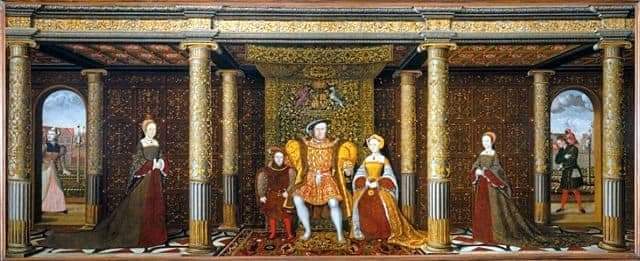
? There’s a portrait that depicts Henry VIII’s ideal family, and it also includes Jane and Henry’s other fool, Will Somers.
Jane is on the far left side, and Will Somers on the far right.
Historians have wondered whether the two were married or simply worked together.
They sometimes wore the same outfits too!
? Mary I also employed Lucretia the Tumbler. Lucretia and Jane the Foole are known to have performed together, and Lucretia may have been Jane’s minder.
Sadly, it’s not known what happened to Jane after Mary I’s death in 1558.
Jane does not appear in the records in Elizabeth I’s reign.
Perhaps she joined the household of one of Mary’s former attendants, or perhaps she died soon after her mistress.
What we do know is that she was well looked after at the royal court for over two decades.
About The Author


