
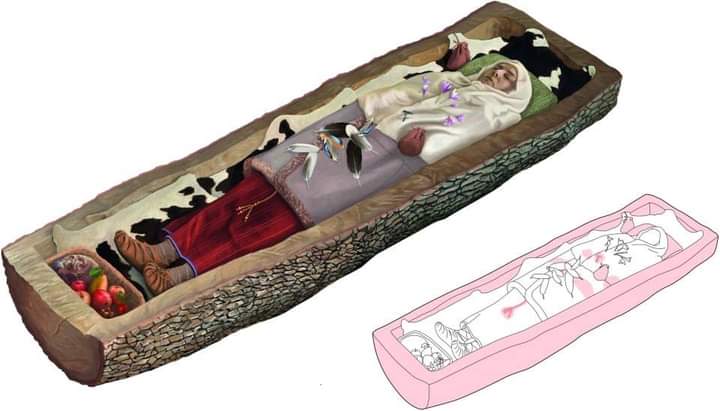
? Celtic Woman Buried In A Tree in Switzerland ?
.
? Some 2,200 years ago, a group of Iron Age Celts laid a woman to rest in what is now Zürich, Switzerland.
The woman was dressed finely in a dress of fine sheep’s wool, a shawl and a sheepskin coat.
She had with her some amazing accessories ~ including a necklace made of blue and yellow glass and amber, bronze bracelets, and a bronze belt chain decorated with pendants.
? Its estimated the woman was roughly 40 years old, when she died.
Analysis of her teeth, discovered she had a substantial sweet tooth, and consumed a sugar-rich and starchy diet.
Based on analysis of her remains, archaeologists theorize she performed little physical labor during her lifetime, so was likely an individual of high status.
? Impressively, the woman was buried in a hollowed-out tree trunk.
The trunk still had bark on its exterior upon it’s rediscovery in March 2017.
According to the 2017 statement, researchers launched a comprehensive assessment of the grave, and its occupant soon after the discovery.
? Archaeologists have documented, salvaged, conserved and evaluated the various goods found in the tomb, as well as conducting a physical examination of the woman’s remains and performing isotope analysis of her bones.
? The woman was found 260 feet away from a previous discovery of a male in 1903.
Like the woman, the man showed signs of high social standing, wielding a sword, shield and lance and wearing a complete warrior outfit.
Given the fact that the pair were both buried around 200 B.C., it is quite possible they knew each other.
? Today, the Celts are often associated with the British Isles.
In actuality, Celtic clans spanned much of Europe, settling down in Austria, Switzerland and other areas north of the Roman Empire’s borders.
From 450 B.C. to 58 B.C, exactly the time period in which the tree coffin woman and her potential male companion lived, a “wine-guzzling, gold-designing, poly/bisexual, naked-warrior-battling culture” dubbed La Tène thrived in Switzerland’s Lac de Neuchâtel region.
? Unfortunately for these hedonistic Celts, an invasion by Julius Caesar abruptly ended the festivities…paving the way for Rome’s eventual subjugation of much of the European continent.
About The Author


