
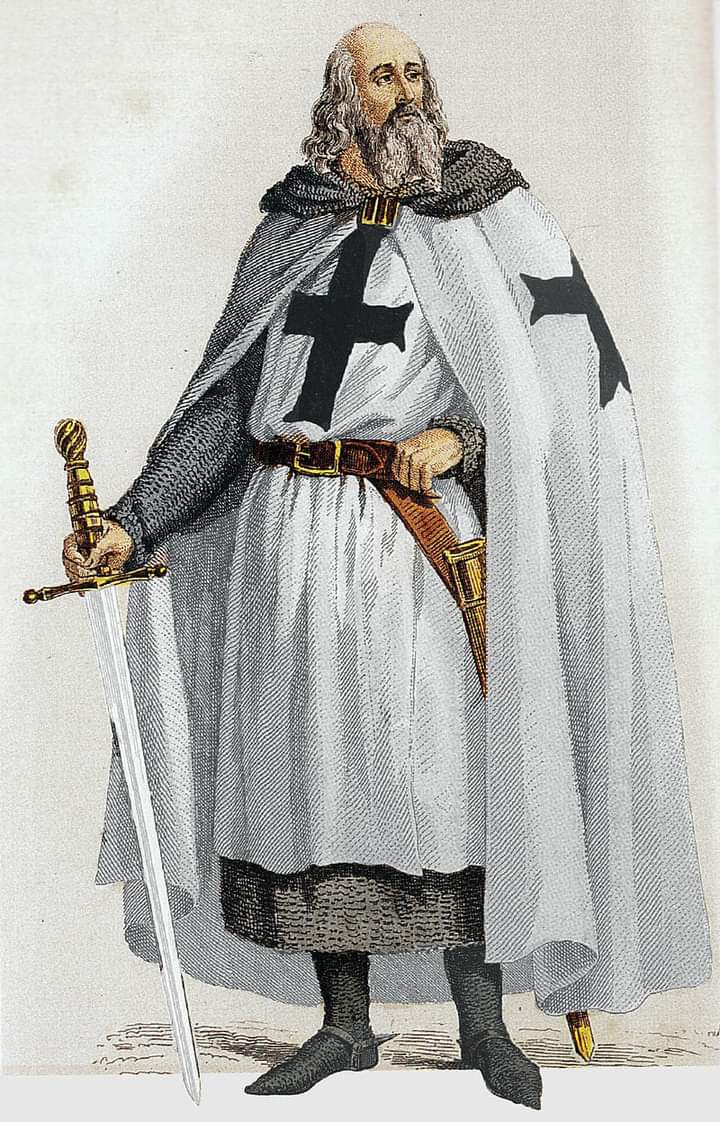
Jacques de Molay, French last Grand Master of The Knights Templar, dies burned at the stake
.
“A Templar Knight is truly a fearless knight, and secure on every side, for his soul is protected by the armour of faith, just as his body is protected by the armour of steel.
He is thus doubly armed and need fear neither demons or men”.
— Bernard of Clairvaux.
During the early to mid-twelfth century the Muslim world began to unite under leaders such as Saladin.
Around this time, cracks appeared amongst the Christian rulers representing a number of factions in the Holy Land.
This included the Knights Hospitaller and the Teutonic Knights.
Jerusalem was taken by the Muslims after the devastating Battle of Hattin in 1187, reclaimed by the Christians in 1229 and then recaptured by the Muslims in 1244.
When the seaport city of Acre fell into Muslim hands in 1291, with it went the last Crusader stronghold in the Holy Land.
It signalled the death knell – literally and metaphorically – for the Knights Templar….
Over the next decade or so, the support the order had enjoyed began to dwindle.
With no Holy Land to defend, had the story of the Knights Templar run its course?
Were they a spent force?
In addition, Europe’s religious and secular rulers became increasingly critical, and vocally opposed to the Orders wealth and power.
By 1303, the Knights Templar’s role in the Holy Land had become redundant, and the order relocated to Paris.
An odd decision perhaps, on the basis that the French king Philip IV had resolved to bring down the Knights Templar.
He proved to be motivated, determined and ruthless.
⚔ On Friday 13th October 1307, King Philip IV ordered every French Knight Templar to be arrested, including the order’s last Grand Master, Jacques de Molay.
Philip wanted the possessions confiscated to incorporate their wealth into the Royal Treasury, and to be free of the enormous debt he owed the Templar Order.
Jacques de Molay was the 23rd and last grand master of the Knights Templar.
He led the order from 1292, until it was dissolved by order of Pope Clement V in 1312.
Though little is known of his actual life and deeds except for his last years as Grand Master, he is one of the best known Templars.
The Templars were brutally tortured and forced to confess to outrageously trumped-up charges.
This included homosexuality, devil worship, heresy, financial corruption, fraud, spitting on the cross, idolatry, obscene kissing and the denial of Christ.
Punishments for the guilty ranged from excommunication and perpetual imprisonment, to burning at the stake.
On 18th March 1314 Jacques de Molay was burned to death, aged 70.
Of Molay’s death, Henry Charles Lea gives this account:
” On 18 March 1314, when, on a scaffold in front of Notre Dame, Jacques de Molay, Templar Grand Master, Geoffroi de Charney, Master of Normandy, Hugues de Peraud, Visitor of France, and Godefroi de Gonneville, Master of Aquitaine, were brought forth from the jail in which for nearly seven years they had lain.
The canons pronounced that a relapsed heretic was to be burned without a hearing;.
That same day, by sunset, a pyre was erected on a small island in the Seine, the Ile des Juifs, near the palace garden.
There de Molay, de Charney, de Gonneville, and de Peraud were slowly burned to death, refusing all offers of pardon for retraction, and bearing their torment with a composure which won for them the reputation of martyrs among the people, who reverently collected their ashes as relics.”
The Templars were no more……
Their legacy, however, endures in a number of ways.
They are present in our architecture in the form of stunning buildings such as Temple Church in London, Rosslyn Chapel in Scotland and much of Acre in Israel.
The sudden arrest of the Templars, the conflicting stories about confessions, and the dramatic deaths by burning, generated many stories and legends about both the Order, and its last Grand Master.
Dozens of modern-day organisations claim heritage from the Templars.
They are the supposed forerunners of the Freemasons and the Illuminati.
The Templars are supposed to have discovered America in the late 14th century, 100 years before Columbus.
There are absurdly tenuous connections to 9/11 and the legend of King Arthur.
Thanks to The Da Vinci Code, Dan Brown put the Knights Templar back into modern culture, exactly as they were 850 years ago.
Most pervasively, The Templars are present in our myths, stories and legends.
The Templars are portrayed as protectors of the Ark of the Covenant, the Shroud of Turin and even the bloodline of Christ.
Some, all, or none of these relics could be at Rosslyn Chapel, or on Oak Island off the coast of Nova Scotia.
Just waiting to be discovered….
About The Author


