
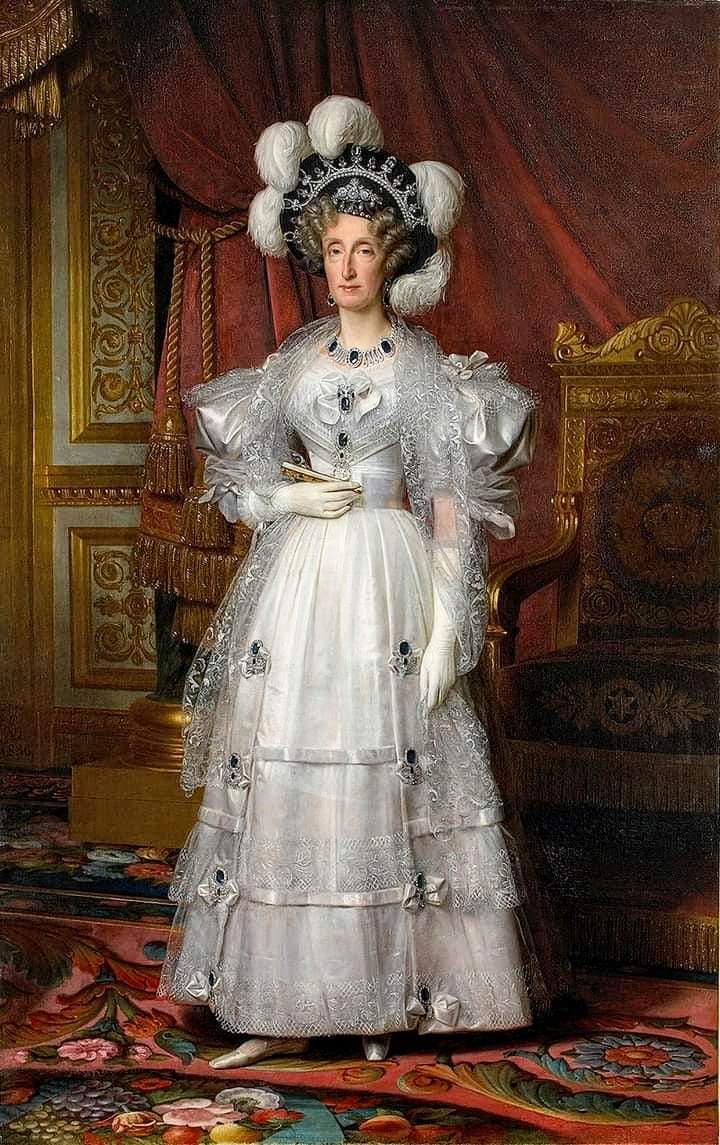
Birth of Maria Amalia, of Bourbon-Sicily, French queen as wife of Louis Philip of Austria
Maria Amalia of Naples and Sicily was born on 26th April 1782 as the daughter of Ferdinand I of the Two Sicilies and Maria Carolina of Austria.
Maria’s mother was a sister of Queen Marie Antoinette of France.
Maria was an inquisitive little girl, and learned to read at an early age.
She often went hunting with her father, and would grow up to be an excellent horsewoman.
At a young age, Maria was betrothed to her cousin Louis Joseph, Dauphin of France, but he would die in 1789.
From 1800 until 1802, Maria, her mother and several siblings lived in Austria, where her mother searched for suitable matches for her daughters.
In 1802, the family returned to Naples, but with Napoleon approaching, the family fled to Sicily.
Napoleon proposed a match for Maria with his stepson Eugène de Beauharnais, but it was promptly rejected.
In 1808, Louis Philippe, Duke of Orléans arrived in Sicily.
He would become Maria’s future husband.
Maria Amalia wrote about their first meeting,
“He is of middle height, inclined to be stout.
He is neither handsome nor ugly.
He has the features of the House of Bourbon and is
very polite and well educated.”
The wedding took place on 25th November 1809.
Maria’s wedding dress was made of cloth of silver, and she wore a diamond tiara and white feathers in her hair.
The following year, Maria Amalia gave birth to her first child, a son named Ferdinand, the future Duke of Orléans.
Two daughters, Louise and Marie, followed in 1812 and 1813.
The fall of Napoleon restored King Louis XVIII to the French throne.
Marie’s husband Louis Philippe, was received kindly and restored to his old rank in the French army.
He was also given all the estates the Orléans family had previously possessed.
In July 1813, Louis Philippe went to fetch Maria and his family, to return to Paris.
King Louis XVIII was quite fond of Maria, she was also introduced to Madame Royal ~ the daughter of Marie Antoinette.
At the Palais Royal in Paris, Maria gave birth to her second son, Louis, Duke of Nemours.
Napoleon’s brief return after his escape from Elba, saw the family flee to England.
With Napoleon’s final defeat, the family returned to the Palais Royal in 1817, just a month after Maria Amalia had given birth to another daughter, Clémentine.
Maria gave birth to a third son François, Prince of Joinville in 1818, and a fourth son Charles, Duke of Penthièvre in 1820.
A fifth son Henri, Duke of Aumale was born in 1822, followed by her sixth son and final child Antoine, Duke of Montpensier in 1824.
The years between 1825 and 1830 were ones of domestic bliss for Maria.
However, by 1830 her husband was out of favour with the King, and they were also standing on the edge of another revolution.
Maria spent a lot of time in prayer……
The King eventually abdicated in favour of the Duke of Berry’s 9 year-old son, and appointed Maria’s husband as regent, and Lieutenant-General of the Kingdom.
However, Maria’s husband eventually accepted the crown for himself, after he agreed to accept a constitution.
This made Maria queen.
Maria was horrified, and she sobbed,
“What a catastrophe.
They will call my husband a usurper!”
In August 1830, her husband was declared, “King of the French by the Will of the People”, rather than “King of France by the Grace of God.”
Maria Amalia did not have an official declaration as Queen of the French, but she was thereafter referred to as Queen.
Maria and her husband reluctantly stepped into their new role.
Her husband continued to claim that he only accepted the crown to save the country from anarchy.
Paris was restless, and the family eventually settled in the Tuileries, where her husband had a moat dug under their windows, saying,
“I do not intend my wife’s ears to be polluted with
the horrors Marie Antoinette had to endure, when
the people had the entrance to the gardens and
could come close to the windows.”
The greatest joy of Maria’s life was her family, and they soon settled into a routine.
Maria rose early, doing her toilette, and opening her correspondence.
She would then hear mass and have breakfast with her family, then she would then sit and work with her daughters, on embroidery until noon.
The afternoon was spent holding audiences, before continuing to work with her secretaries on petitions and charitable works.
At one point, she gave away 400,000 francs of her private income of 500,000 francs to charity.
The next few years saw Maria’s children get married, and have children of their own.
During these years, she became more and more religious, spending long hours at prayer.
In 1843, the family was visited by Queen Victoria, and while Maria’s husband made a return visit the following year, she did not join him.
Another wave of revolutions rocked Europe in February and on 24th February 1848, Maria’s husband abdicated in favour of their nine-year-old grandson.
It soon became apparent that their young grandson was not accepted, and France declared itself a republic.
The family made their way to England.
Queen Victoria decided to place Claremont at their disposal, as a residence.
Maria’s husband only survived his abdication for two years, dying at Claremont on 26th August 1850.
Maria would survive him for 16 years, but wasn’t lonely, as she was surrounded by her children and grandchildren.
By January 1866, Maria’s health visibly began to fail her.
She went on a drive on 18th March but remained in her bedroom the following day.
Over the next few days, she was hardly able to stay awake, and the family began to gather around her.
She was able to hold their hands but could not speak to them.
A priest was called, and he recited the prayers for the dying.
Maria died on 24th March 1866, at the age of 83.
Maria’s coffin was placed beside that of her husband’s, where they remained in the chapel of the cemetery at Weybridge.
Here they lie, side by side in the chapel, until they were moved to the family chapel at Dreux, in 1878.
Maria Amalia of Bourbon~Sicily ~ French queen.
Portrait by Louis Hersent, c. 1836
About The Author


