
In the late 6th century, Rome sent a man to England to bring Christianity to the Anglo-Saxons. He would later become the first Archbishop of Canterbury and kick-start the country’s conversion to Christianity. This man was Augustine.
Very little is known of his early life before he was the champion of Christianity in England. But he was most likely a monk living in Rome when Pope Gregory the Great chose him to lead a mission to convert the pagan Anglo-Saxons to the Christian faith in 595.
Christianity was not new to England; it had been present during Roman times, but the arrival of the Saxons had reverted most of the population back to paganism.
England as we know it today did not exist at that time; in the 6th century, it was divided into several, often warring, kingdoms. One of these was Kent, under the reign of King Æthelberht, and it was here that was chosen as the starting point for Augustine’s mission in England.
Augustine arrived in Kent with forty monks, and King Æthelberht met them with a group of people. He was wary of his new visitors but allowed them to preach at the gathering.
King Æthelberht’s wife, Queen Bertha, was a Frankish princess who was already a Christian, despite her marriage to a pagan king. She is known to have been in contact with the Pope around this time, and it is possible this is why Kent was chosen for Augustine’s first mission. Æthelberht himself was a pagan, but he allowed his wife to practice her religion freely.
Augustine and his companions were treated with great hospitality by the king. They were given freedom to preach and invited to reside in Canterbury, the capital of Kent. Augustine and his companions held services in the ancient church of St. Martin’s, which is believed to be the church that Queen Bertha herself worshipped in.
King Æthelberht did convert eventually, and the abbey of St. Peter and Paul (later St. Augustine’s Abbey) was founded in Canterbury in about 598. Augustine became the first Archbishop of Canterbury; this role is still the most senior cleric in the Church of England.
King Æthelberht was generous to Augustine; his gifts enabled the creation of a school and a library at the abbey, which in turn established it as an important seat of learning. Pope Gregory even sent books from Rome to fill the abbey’s bookshelves. Æthelberht also provided protection to the new Christian church. With Augustine’s input, he made laws that protected church property and punished transgressions against the church even more harshly than those against the Crown.
Augustine died on May 26, but there is contention over the year, with some scholars reporting 604 and others 609. His mission continued after him as Christianity spread throughout the other English kingdoms, but the Christianisation of the Anglo-Saxon kingdoms would not be complete until the 7th century, when the Isle of Wight’s last pagan king, Aruald, died in 686.
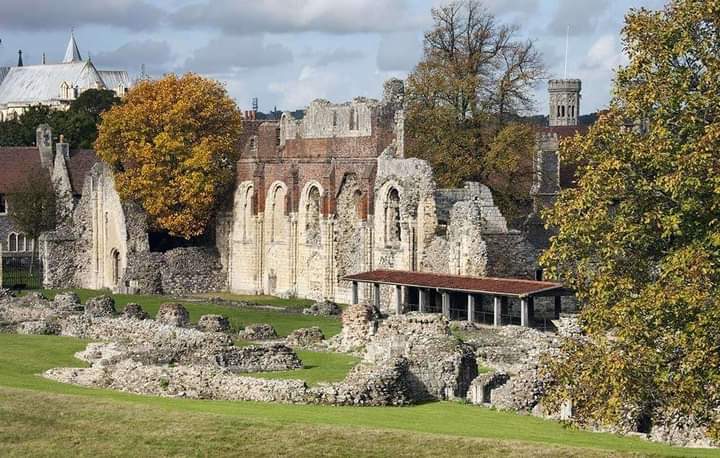
St. Augustine’s Abbey became one of the most important Benedictine monasteries in the medieval world and was a thriving centre of learning and culture for almost 1,000 years before its suppression in 1538 by Henry VIII. It is the burial place of several Anglo-Saxon kings and archbishops of Canterbury, including St. Augustine himself, and today forms part of a UNESCO World Heritage Site.
Picture: St. Augustine’s Abbey
About The Author


