
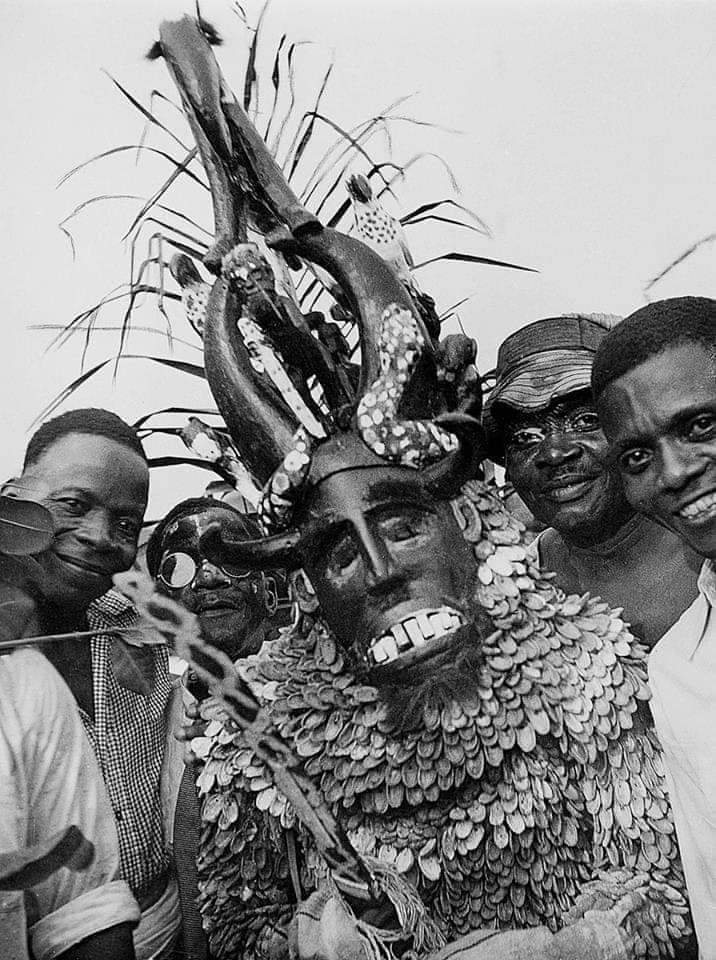
A Glimpse into the Early Igbo Presence in Yorubaland
The attached photographs showcase a lively masquerade dance, featuring the renowned Mgbedike masquerade, which was immensely popular in the Nri-Ọka region. Notably, Picture 1 captures a man sporting a hat adorned with ichi marks on his face.
Surprisingly, these pictures were not captured within Igboland but rather in Okitipupa village, situated in the Ondo area of eastern Yorubaland during the 1940s. They were taken by British colonial officer Edward Harland Duckworth. This raises the question: who were these people, and what brought the Mgbedike masquerade to Yorubaland during the ’40s?
According to the Ọka tradition, their wandering blacksmiths had ventured into Yorubaland at an unspecified time in history. Professor O. N. Njoku posits that this migration occurred sometime between the 1890s and 1904. However, it was during the Colonial Period, starting from the 1930s, that their presence became noticeable enough for Yoruba tradition to acknowledge.
The pre-eminent reason the Ọka were able to infiltrate Yorubaland can be attributed to their exceptional gun-smithing skills. In contrast to Yoruba gunsmiths who utilized nails and rivets for their firearms, Ọka smiths employed screws. This technique allowed Ọka guns to be disassembled, cleaned, and reassembled with ease.
During the 1930s, a renowned Ọka smith named Godwin Okafọ settled in Igede Ekiti, becoming a prominent figure among the locals. The people of Ekiti were acquainted with him simply as “Ọka” since they were unaware of his true name. His arrival marked a period of innovation and advancement within the smithing tradition of Igede, which aligns with the impactful changes his fellow Ọka craftsworkers were implementing in various Ekiti towns.
Chief Akande, a respected elder from Igede, offers insight into Godwin and his “brothers” with the following statement:
“These Isobos, originally referring to Urhobos but extended to anyone from the Eastern Region, arrived and began crafting heavy-duty guns capable of simultaneously killing 2 or 3 animals. They were the first to mass-produce knives, cutlasses, hoes, and other tools for sale. Take a look at Awka, he may be small in stature but possesses more strength than many around us. He was the pioneer of short guns in our area, deviating from the customary long guns. Not only that, these Awka people astonished us further by producing double-barrel guns, which, in times of war, could decimate an entire district…”
(The excerpt is sourced from “Economic History of Ekiti People in Nigeria, 1900 – 1960” by Jumoke Oloidi, PhD Thesis, UNN
About The Author


