
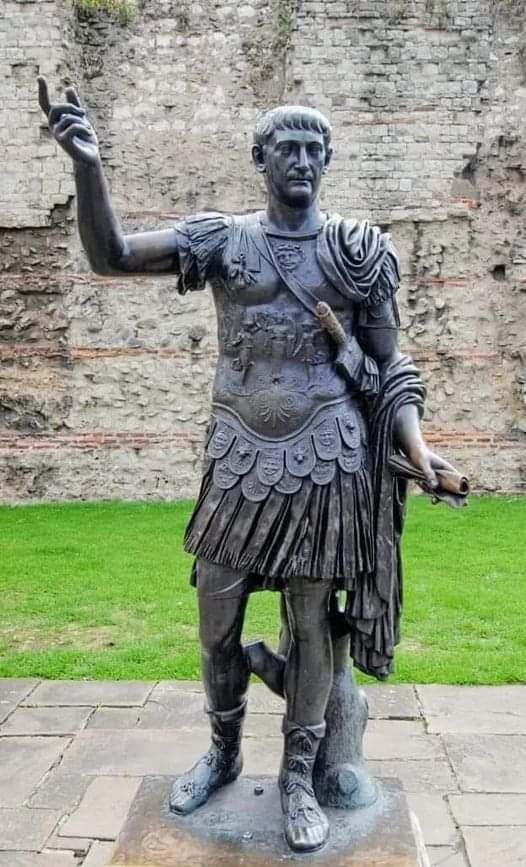
Trajan Becomes Emperor of Rome
Trajan Emperor of Rome, is one of the only rulers whose stellar reputation has endured for almost two thousand years.
Trajan’s reign can be likened to that of Æthelstan, the first king of England, in that he was an accomplished soldier, a highly regarded statesman, politician and diplomat and a legendary empire builder.
Marcus Ulpius Traianus, was born in on 18th September 53 AD in Hispania Baetica, on the outskirts of modern-day Seville in Spain.
His father was a Roman senator and army general under the emperor Vespasian.
Not much is known about Trajan’s childhood, except that he followed his father as he travelled around the empire.
Trajan joined the army and served variously as a tribunus legionis (a tribune, one of six in a legion) and a legatus (a legate, a high-ranking officer equivalent to a general or deputy general) with the Legio VII Gemina.
In his late 30’s, he was appointed consul, one of Rome’s most senior positions.
Trajan gave money to support the children of the poorest in Rome, he built roads, aqueducts, bridges, triumphal arches, the harbour at Ostia Antica, and public baths.
His most famous projects include Trajan’s Market, Trajan’s Column, built to commemorate his victories in the Dacian Wars and Trajan’s Forum, the largest and most spectacular of Rome’s imperial forums.
Around the year 91, Trajan married Pompeia Plotina, a noblewoman from the Roman settlement at Nîmes.
The marriage ultimately remained childless.
Historians later noted that Trajan was a lover of young men, in contrast to the usual bisexual activity that was common among upper-class Roman men of the period.
Trajan’s lovers included the future emperor Hadrian, pages of the imperial household, the actor Pylades, and a dancer called Apolaustus.
Early in 117, Trajan grew ill and set sail for Italy.
His health declined throughout the spring and summer, and he died on 11th August 117, aged 63.
Trajan was cremated, his ashes were returned to Rome and spread at the foot of his eponymous column.
Just before his passing, Trajan adopted Hadrian and named him as his successor.
In the nineteen-year reign of Trajan, Rome further dominated its rivals, and the empire became larger than it had ever been before.
The first emperor born outside Italy, Trajan brought prosperity and peace to Rome, and was declared optimus princeps or ‘best ruler’ by the Senate.
The statue of Trajan is an outdoor twentieth-century bronze sculpture located in front of a section of the London Wall built by Romans, at Tower Hill in London, United Kingdom.
Photo: claudiodivizia via Getty Images
About The Author


