
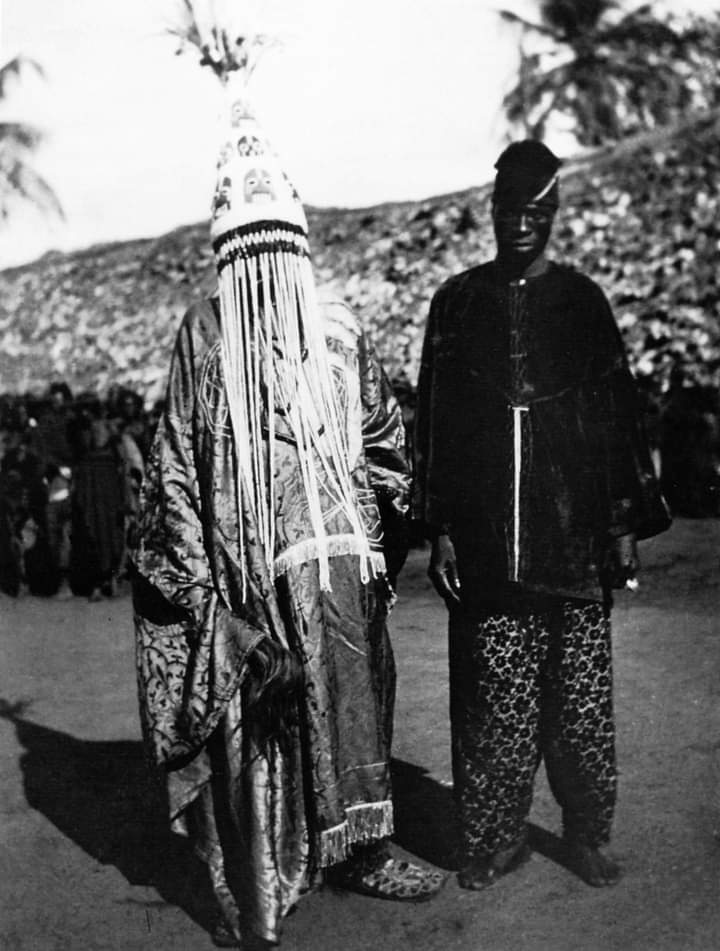
Creator:
“Olówè of Isè: A Yoruba Sculptor to Kings
Olówè’s mother was living as a prisoner of war in
Efon Alaye when she gave birth to him and a sister from around 1873 to 1877.
After the father had managed to purchase his family’s freedom, Olówè spent most of his life in Ife and reportedly died in 1938 or 1939.
Olówè began carving when he first started to earn his living as a youth in Ife with all kinds of lowly jobs as one of the many hundred errand boys (elemoso) at the court of the king (Arinjale).
The question as to whether he had any teacher(s) or whether he taught himself his profession alone by means of his talent remains unanswered.
As a master carver, Olówè developed a distinctive style characterised, in particular, by figures carved with
perspective, asymmetries, high reliefs and the depiction of movement.
He worked in a geographic area of about a hundred square kilometres around the town of Ife. His works have
been documented in the royal palaces of the towns of Isè, Ikéré, Owo and Akure, as well as Ikare, Igede, Ukiti, Ogbagi, Use and Ogotun.
In Europe, people became aware of his artistic
creations in 1924 at the British Empire Exhibition in Wembley. There a magnificent door on loan from the Ikéré palace was much admired in the exhibit at the Nigerian pavilion.
Credit: National Museum of African Art, Smithsonian Institution, Washington, D.C., 1998.
Please note: I have tried to check other sources to corroborate this photo but my check has been unsuccessful. This is the only photo I have seen of this master wood carver. But I want to believe this source is real. But who knows, somebody on this platform can have another photo or another opinion on the photo. Kindly let us know.
About The Author


