
Inês de Castro – The Corpse Bride of Portugal
Its a well known fact, that when it comes to royalty or nobility, marriages are usually arranged by the respective families.
Influence, wealth, titles and alliances all play their part, with the bride and groom having very little say in their future spouse.
These political arrangements were essential for power, there was no room for love.
In the case of Prince Pedro of Portugal and Lady Inês de Castro, they were willing to defy this notion.
Sadly, not even a king’s forbidden love was safe from fate’s cruel designs.
King Pedro was a 14th-century Portuguese king, while Inês de Castro was a lady-in-waiting in the court of Pedro’s wife.
After the two fell madly in love, it caused quite a stir in the royal family – and would begin a tale of murder, war, and a rather gruesome coronation.
Don Pedro I was born in Coimbra in 1320, the only son of King Alfonso IV and Queen Beatrice, heir of the throne of Portugal.
When just a boy, he was married to Lady Constansa Manuel of Castela and Leão.
Pedro didn’t love her, but he had nothing to say about his own choices in regards to his duty to the realm.
Even though he was already married, he fell in love with another woman, his own wife’s lady-in-waiting – Inês de Castro.
Inês was a young woman of immense beauty, with blonde hair and eyes blue as the clear sky.
Inês was a Galician noblewoman, however, her parents were unmarried, which meant that Inês was illegitimate.
Not quite a good fit for a future King, but she returned his feelings.
Their relationship however was not very discreet, and Pedro’s father Alfonso tried to set them apart by sending her away.
Even then, they still exchanged letters, distance couldn’t keep their love apart.
In 1345, Constansa died during childbirth.
Don Pedro, now free of his arranged marriage’s ties, brought his beloved Inês back from exile.
Their union caused a great scandal among the court.
In 1350, Inês gave birth to their first child, Afonso, who died shortly after his birth.
In 1352, their second child John, Duke of Valencia de Campos was born, followed by Denis, Lord of Cifuentes in 1353 and Beatrice, Countess of Albequerque in 1354.
King Alfonso tried several times to arrange for his son to be remarried, but Pedro refused to take a wife other than Inês.
Sadly for Pedro, Inês was not deemed suitable to be a queen.
King Alfonso was outraged over his son’s choice.
Inês brought nothing to offer to Portugal, no political alliances, and no money.
He wanted his son to marry another Castilian princess.
Pedro then claimed he was not free to marry.
He had married Inês in secret in 1354, despite the fact that Alfonso had forbidden it.
King Alfonso would not accept the validity of a secret wedding, however, he was still worried about the possibility of Inês becoming queen.
Persuaded by three of his nobles, King Alfonso decided that to ensure stability to the realm, Inês needed to be removed permanently.
She needed to die.
On 7th January 1355, while Don Pedro was away hunting, three men sent by King Alfonso found Inês with one of her children.
The men murdered the 29 year old Inês, in front of her own child, by viciously decapitating her on the spot.
When Pedro returned, he was horrified to find Inês blood spilled across the floor.
When he learned his father was behind Inês’ death, he was driven mad with grief.
Pedro loved Inês, more than anything in this Earth.
Such was his fury, that Pedro declared war against the King, launching Portugal into a civil war.
The conflict ended however, when the Queen-Mother Beatrice, intervened between the two, and proposed a truce.
However, racked with grief, Pedro was reduced to a shadow of his former self.
In 1357, King Afonso died and Pedro ascended to the throne of Portugal.
Still heartbroken over Inês’ death, his first act as King was to hunt down all conspirators in her murder.
In an extremely hardcore and brutal fashion, the king had them ex3cuted by ripping their hearts out, while they were still alive.
Pedro was glad to have some sense of revenge, but it was not enough.
He still needed his queen.
Pedro revealed his secret marriage to Inês, and claimed her the rightful Queen of Portugal.
Therefore, he reasoned, she deserved a coronation…..
Pedro then had Inês body exhumed from her grave in the church of Santa Clara.
Inês corpse is over two years old at this point, but Pedro had her dressed in the finest clothes and jewels, and the corpse was decorated to make the queen seem as though she was alive.
He then ordered her decomposed corpse to be sat on the throne beside him.
An official ceremony was then called.
In attendance were nobles, clergy members and peasants alike, who all arrived at the palace to find Inês corpse sat upon the throne, awaiting her coronation.
The ceremony was conducted, which makes Inês the only queen crowned posthumously.
King Pedro then forced the noblemen, the clergy and the peasants to bow before his dead queen, and kiss her hand.
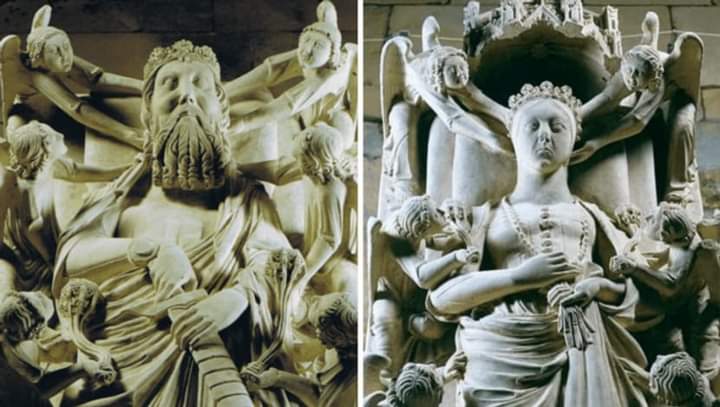
After her ‘coronation’, Inês was buried at the Monastery of Alcobaça where her coffin can still be seen.
When Pedro died in 1367, he had his body buried next to his beloved Inês.
Both marble coffins are exquisitely sculpted with scenes from their lives.
The tombs were not put one beside the other in the usual manner, but facing each other.
According to the legend, at the Last Judgment Pedro and Inês can look at each other as they rise from their graves.
The words in the marble read –
“Até o fim do mundo…”
“Until the end of time…”
.
? Tombs of King Pedro & Inês de Castro.
Monastery of Alcobaça.
About The Author


