
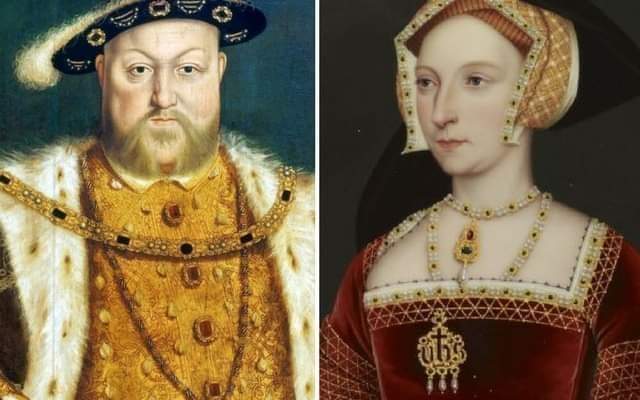
HENRY & JANE
Jane Seymour was born around 1509, most likely at Wolf Hall in Wiltshire, England.
She was the daughter of Sir John Seymour and Margery Wentworth.
The Seymours owned more than 100 manors and five castles – Jane was considered quite a prize as a member of such a prestigious family.
Jane was a descendant of Edward III, and through this, she was a 5th cousin to her future husband, Henry VIII.
Jane also shared a great grandmother, Elizabeth Cheney, with Henry’s second and fifth wives, Anne Boleyn and Catherine Howard.
Jane was not as highly educated as Henry’s first two wives – Jane was the very picture of wifely obedience and maidenly behaviour.
She could read and write a little, but was much better at needlework and household management, which were considered much more necessary for women.
Her needlework was reportedly beautiful and elaborate.
Some of Jane’s needlework survived as late as 1652, when it is recorded to have been given to the Seymour family.
In 1532, Jane became a Maid-of-Honour to Queen Katharine of Aragon.
She would also go on to serve Queen Anne Boleyn, and that was when she caught the attention of Henry.
Jane would certainly have witnessed firsthand many of the dangers – and rewards – of a relationship with the King.
Having spent years at court, and having seen the King tire of two queens, Jane may have been quiet – but she knew how to play the game.
In late January 1536, Anne Boleyn blamed Jane for her miscarriage.
Anne was aware of the developing relationship, complaining to Henry that she had
“caught that abandoned woman Jane, sitting on your knees”.
Anne’s failure to bear a son was an opportunity for Jane.
When Henry sent her a letter and a purse of gold, she refused them, declaring that-
“she had no greater riches in the world than her honour, which she would not injure for a thousand deaths”.
An action which was almost similar to what Anne Boleyn did first……
Once again, as it had with Anne, Henry was smitten with this show of virtue, henceforth insisting on meeting her only with a chaperone.
By 1535, Jane was in her late twenties, and was highly praised for her gentle, peaceful nature.
She was a peacemaker at Court, and well liked.
According to the Spanish Ambassador Eustace Chapuys, Jane was of middling stature, and very pale, and not of much beauty.
Another courtier commented that Jane was- “a woman of the utmost charm, in both character and appearance.”
She was regarded as meek, gentle, simple, and chaste.
Jane seems demurely or tactically, refused the King’s advances.
However, their relationship was already established by the time Anne Boleyn was in the Tower of London.
During April Henry and Jane were reportedly already discussing their wedding – while Anne was still trying to hold on to her marriage.
Henry was betrothed to Jane on 20th May 1536, the day after Anne Boleyn’s exEcution.
They were formally married at the Palace of Whitehall, London on 30th May, just 11 days after the death of Anne Boleyn.
As a wedding gift Henry granted Jane 104 manors in four counties, as well as a number of forests and hunting chases for her ‘jointure’ – the income to support her during their marriage.
Jane, took as her motto “bound to obey and serve” – of course she did.
She presented herself as always obedient.
She was publicly proclaimed queen on 4th June 1536, but was never crowned because of plague in London, where the coronation was to take place.
As queen, Jane was said to be strict and formal.
The lavish entertainments, gaiety, and extravagance of the queen’s household, which had reached its peak during Anne Boleyn’s time, was replaced by strict decorum.
Jane used her new-found position to get her brothers Edward and Thomas into high positions at court, and tried to remove Anne’s famously flirtatious French fashions from court life.
Jane had repeatedly attempted to allow Princess Mary back to court, Henry reminded her that she should only concern herself with her own children.
When Mary did eventually appear at court again, Jane made the perfect step-mother.
She was generous, kind and motherly, bonding over their shared Catholicism.
Jane also made an effort to restore Mary to court, and to the royal succession – behind any children she might have with Henry.
While she was unable to restore Mary to the line of succession, she was able to reconcile her with Henry.
During Jane’s tenure as Queen, Princess Elizabeth was constantly neglected, so much so that her governess repeatedly appealed to the Royal Family to buy the princess new clothes as the child had outgrown them all.
When Elizabeth finally did appear at court, Jane had ordered for the child to be sat at a distant table, away from her family.
Poor Elizabeth, only around five years old, must have been confused and terrified.
Her new mother-figure alienating her from her father, and those of whom she would have been familiar with.
One non-contemporary source says that Jane may have been pregnant, and had a miscarriage by Christmas 1536, however, in January 1537, Jane conceived again.
During her pregnancy, she developed a craving for quail, which Henry ordered for her from Calais and Flanders.
During the summer, she took no public engagements and led a relatively quiet life, attended by the royal physicians and the best midwives in the kingdom.
Jane went into confinement in September 1537.
At two o’clock in the morning of 12th October 1537, at Hampton Court Palace, Jane gave birth to the coveted male heir – the future King Edward VI.
The Tudor line seemed secure.
Edward was christened on 15 October 1537, without his mother in attendance, as was the custom.
He was the only legitimate son of Henry VIII to survive infancy.
Both of Henry’s daughters, Mary and Elizabeth, were present and carried the Infant Edward’s train, during the ceremony.
Jane’s labour had been difficult, lasting two days and three nights, probably because the baby was not well positioned.
After the christening, it became clear that she was seriously ill.
Jane died on 24th October 1537 at Hampton Court Palace.
Jane was buried on 12th November 1537 in St. George’s Chapel at Windsor Castle, in which her stepdaughter Mary acted as chief mourner.
A procession of 29 mourners followed Mary, one for every year of Jane’s life.
She was the only one of Henry’s wives to receive a queen’s funeral.
After Jane’s death, Henry wore black for the next three months.
He put on weight during his widowerhood, becoming obese and swollen and developing diabetes and gout.
He married Anne of Cleves two years later.
For the rest of his life, Henry would always claim that the eighteen months in which Jane had been his Queen, were the best of his life.
When Henry died in 1547, he was buried beside her, on his request, in the grave he had made for her.
Their Son succeeded as Edward VI, but died at the age of 15.
Jane Seymour provided Henry with what he wanted most in the world – a son.
For that, he loved her.
However, there was a time when Henry did regret marrying Jane.
Henry mentioned this to one of his companions – having recently taken notice of another woman at court.
In October 1536, Henry snapped at Jane viciously for speaking up against him during the Dissolution of the Monasteries.
Jane threw herself on her knees before the king, begging him to restore the abbeys for fear that the rebellion, known as the Pilgrimage of Grace, was God’s judgment against him.
In response, Henry publicly reminded her of the fate of Anne Boleyn….
One has to wonder, if Jane hadn’t become pregnant and delivered a son, do you think she would be sharing his grave today……
About The Author


