
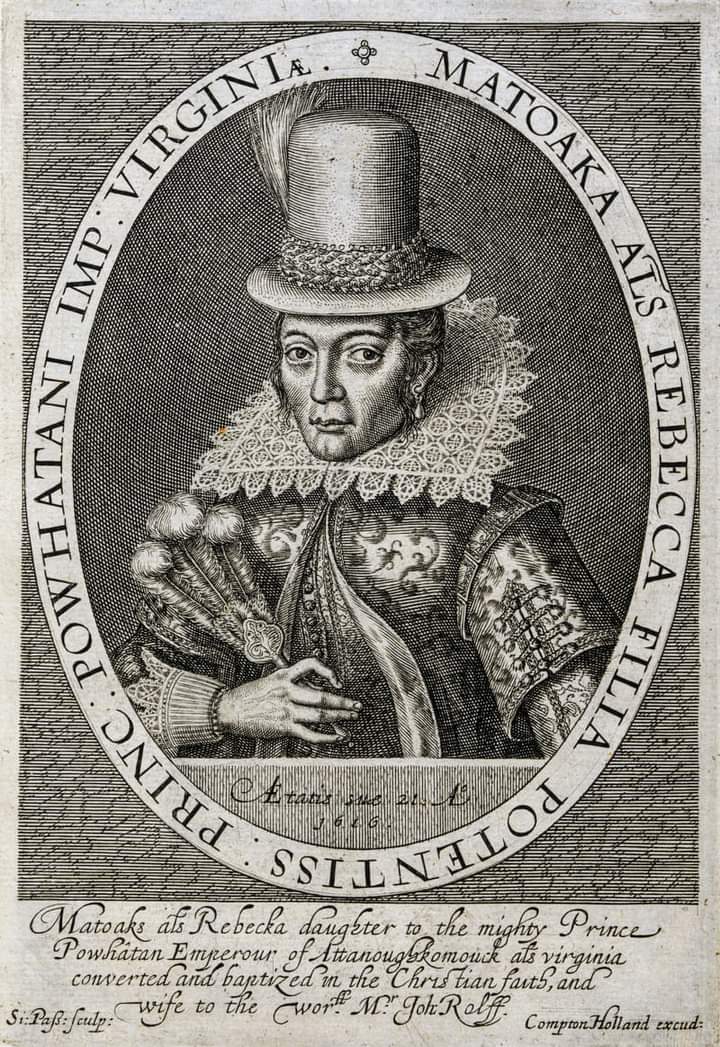
Death of Rebecca Rolfe ~ Pocahontas
The true story of Pocahontas’ short, but powerful life, has been buried in myths that have persisted since the 17th century.
Pocahontas wasn’t even her actual name.
Born about 1596, her real name was Amonute, and she also had the more private name Matoaka.
Pocahontas was her nickname, which means “playful one” or “ill-behaved child.”
Pocahontas was the favorite daughter of Chief Powhatan, the formidable ruler of more than 30 Algonquian-speaking tribes, in and around the area of Jamestown, Virginia.
Little is known about Pocahontas’ mother, and it has been theorised that she may have died in childbirth.
The narrative of Pocahontas allying with the English, and finding common ground between the two cultures, has endured for centuries.
In actuality, Pocahontas’ life was much different than mainstream culture tells it.
Pocahontas is most famously linked to colonist John Smith, who arrived in Virginia with 100 other settlers in April 1607.
Years later, John Smith wrote about how she, the beautiful daughter of a powerful native leader, rescued him from being ex3cuted by her father.
At the beginning of 1609, John Smith led a party to visit Powhatan, and things seemed to be going well.
But in the middle of the night, as the English slept, Pocahontas, came to warn Smith of a plot to kill them.
However, it’s disputed whether or not Pocahontas, then aged 11 or 12, even rescued Smith at all.
The story that Pocahontas was head over heels in love with John Smith, is just romantic fiction.
Early histories, however, do establish that Pocahontas did begin visiting Jamestown with a group of Powhatan’s envoys.
Her presence with them as the chief’s daughter, signaled that they came in peace.
Pocahontas befriended Smith and the colonists.
She often went to the settlement and played games with the boys there.
Pocahontas became friends with 13-year-old Thomas Savage.
Through Pocahontas, Thomas would learn the tribes language and customs, and eventually served as a go-between between Jamestown and the Powhatan’s.
Meanwhile, Pocahontas’ father decided it was time for Pocahontas to enter adult life, and marry.
Pocahontas married a man named Kocoum.
Kocoum was killed by the colonists after his wife’s capture in 1613.
However, Kocoum’s identity, and very existence have been widely debated among scholars for centuries.
A conflict between the Jamestown settlers and the Powhatan’s began late in the summer of 1609.
As the colonists expanded their settlement, the Powhatans felt that their lands were threatened.
Pocahontas was captured and held for ransom by English colonists during the hostilities in 1613.
During this time, a young puritan minister named Alexander Whitaker instructed Pocahontas, about Christianity, and helped heat improve her English.
Sometime in the spring of 1614 Pocahontas renounced her country, and openly confessed her Christian faith, and was baptised.
Her baptismal name was Rebecca, and it was around this time, that John Rolfe began to fall in love with her.
Pocahontas became Rebecca Rolfe, when she married John in April 1614, at the age of about 17 or 18.
The marriage created a climate of peace between the Jamestown colonists and Powhatan tribes.
Soon, their son Thomas Rolfe was born.
Pocahontas and John Rolfe, started growing tobacco, and succeeded in growing a crop that the Europeans would buy.
Tobacco transformed Virginia into an economic success, as smoking went from a pastime for the elite few in Europe, to something everyone could afford.
As a symbol of a tamed “New World savage” and the success of the Virginia Jamestown colony, The London Company decided to bring Pocahontas and her son to London to show off their success.
They arrived in late spring 1616, and were presented as visiting royalty.
Pocahontas was received at the Royal Court, before King James at the old Banqueting House in the Palace of Whitehall ~ in an elaborate ceremony by the Bishop of London.
Pocahontas soon became something of a celebrity, and a curiosity.
She was elegantly dressed, and attended many functions.
Soon Rolfe decided it was time to go back to Virginia.
The rapidly growing city of London was badly polluted ~ both its air and water, and Rolfe began to fear for the health of his little family.
As they were moving down the Thames River to begin their homeward voyage, Pocahontas became very sick.
They stopped, and they went ashore at Gravesend.
Pocahontas died here, on 21st March 1617 aged 20. She was buried at St George’s Church, Gravesend.
Speculated causes of her death include pneumonia, smallpox, tuberculosis, hemorrhagic dysentery, and even poisoning.
Baby Thomas also took sick when his mother did.
John Rolfe left him to be brought up by his brother in Norfolk, for fear he would not survive the long ocean voyage back to Virginia.
Despite her short life, Pocahontas intelligence and willingness to take risks, made her a key figure in the beginnings of early English America.
She adapted to so many difficult situations, in a world so different from the one in which she’d grown up ~ yet always found a way to succeed.
Far from being a side note to the story of American history, she was in fact the hero of the tale, and so much more than a Disney Princess!
About The Author


