
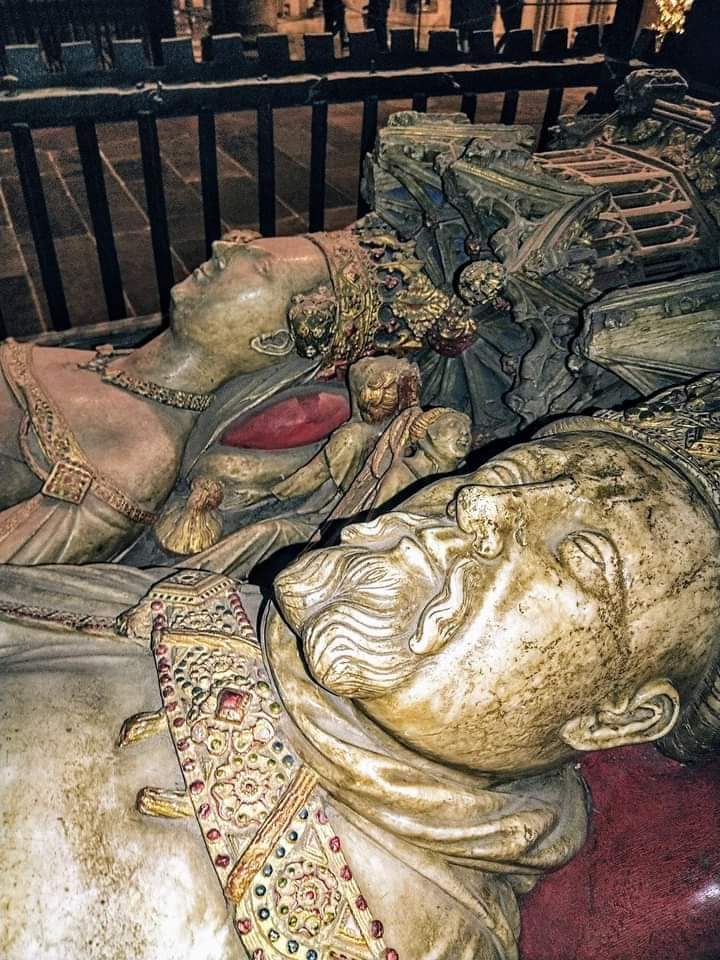
DEATH OF KING HENRY IV OF ENGLAND
Henry was born in April 1366 at Bolingbroke Castle in Lincolnshire, the son of John of Gaunt and Blanche of Lancaster.
Before he became king, he was known as Henry Bolingbroke, Duke of Lancaster.
Henry clashed badly with his cousin, Richard II of England.
Henry was exiled in 1397, but in 1399 he returned to England with a small army.
As King Richards support collapsed, Henry made himself king, kicking off his reign with the murder of his predecessor.
Henry even put the body of Richard on public display in the Tower of London, in case any would-be rebels thought he might still be alive, and ready to head a coup.
The Plantagenets, who had ruled England since Henry II, were now replaced by the House of Lancaster – with Henry as the first of the kings.
On the eve of his coronation, Henry created a new group of knights, called the Knights of Bath.
Henry, himself took a bath every week, an unusual frequency for the Middle Ages.
Henry created 46 such knights, and they all had to have a bath as a mark of purification, and be blessed by a priest before they were invested.
Henry would face major rebellions in both England and Wales, and he frequently clashed with Parliament, particularly the ‘Long Parliament’ of 1406.
The so-called ‘Long Parliament’ sat an unusually long time from March until December, as it deliberated over the ever-prickly issue of state finances.
The king’s high taxes were not yielding any results on the field of battle, the court spending was considered excessive, and Parliament insisted that at the very least, the king must listen to its concerns before endorsing a new round of taxes.
Thus, the ‘Long Parliament’ was another small step on the long road to a constitutional monarchy.
Henry married Mary of Bohun on 5th February 1381, but she died during childbirth in 1394.
The couple’s most famous son was Henry, future Henry V.
Henry married again on 7th February 1403, to Joan of Navarre.
Queen Joan was described as beautiful, gracious and majestic, but some claimed she was also greedy and stingy, and was accused of accepting bribes.
Joan and Henry had no surviving children, but it appears that in 1403 Joan gave birth to stillborn twins.
She is recorded as having had a good relationship with Henry’s children from his first marriage.
The later years of Henry’s reign were marked by serious health problems.
He had a disfiguring skin disease and, more seriously, suffered acute attacks of a ‘grave illness’
He had been wasting away, wracked by disease, possibly leprosy or severe eczema, since 1406.
In addition, the king had suffered multiple strokes at the end of his life.
Mentally, he had long been troubled with remorse, for his treatment of King Richard II.
Henry IV died in the Jerusalem Chamber~Westminster Abbey, on 20th March 1413, around 46 years of age.
At his request, Henry was buried in Canterbury Cathedral, on the north side of Trinity Chapel and directly adjacent to the shrine of St Thomas Becket.
He was succeeded by his 25-year-old son, Henry V of England, who was crowned in Westminster Abbey on 9th April 1413.
Henry V became one of the greatest fighting monarchs of European history, by defeating the French at the Battle of Agincourt in 1415…..
? The tomb of Henry VI and his wife Joan of Navarre in Canterbury Cathedral
Picture credits ~M.Tong
About The Author


