
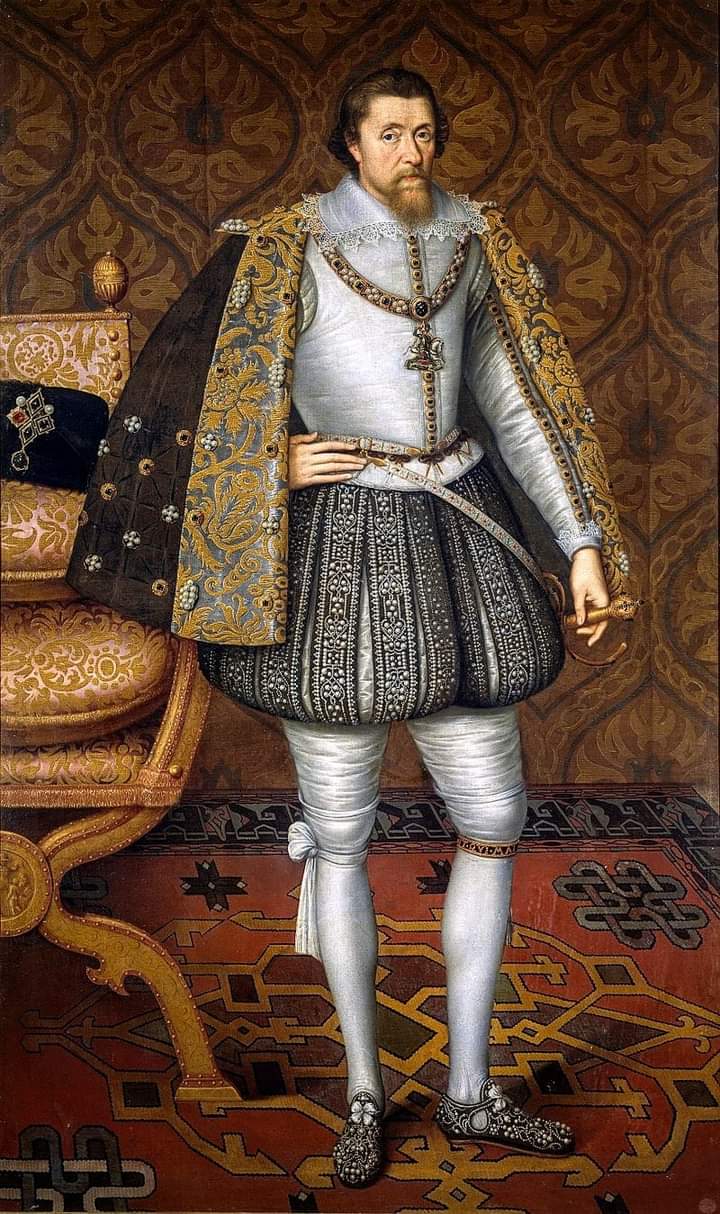
DEATH OF JAMES VI of SCOTLAND & I of ENGLAND
James VI and I, was a hugely significant Stuart king, but has been overshadowed by his notorious relations.
His predecessor in Scotland, his mother Mary Queen of Scots.
His predecessor in England, his cousin Elizabeth I.
His successor in both kingdoms, Charles I.
Born on 19th June 1566, at Edinburgh Castle, James was the product of Mary Queen of Scots ill-fated marriage to her second husband Henry, Lord Darnley.
Both Mary and Darnley, were great grandchildren of Henry VII, through Margaret Tudor.
James’ father Lord Darnley, was murdered on 10th February 1567, at Kirk o’ Field, Edinburgh, and Mary was accused of orchestrating his murder.
Mary was already unpopular, and her marriage on 15th May 1567 to James Hepburn, 4th Earl of Bothwell, who was widely suspected of murdering Darnley on Mary’s orders, heightened widespread bad feeling towards her.
In June 1567, Protestant rebels arrested Mary, and imprisoned her in Loch Leven Castle – she never saw her son again.
Mary was forced to abdicate on 24th July 1567, in favour of her infant son James, and to appoint her illegitimate half-brother, James Stewart, Earl of Moray as Regent.
James was anointed King of Scotland, at the age of thirteen months, at the Church of the Holy Rude, in Stirling.
On 23rd January 1570, James’ uncle, the Earl of Moray, was assassinated.
The next Regent was James’s paternal grandfather, Matthew Stuart, 4th Earl of Lennox.
James was proclaimed an adult ruler on 19th October 1579, he was fifteen years old.
Between 1584 and 1603, James established an effective royal government, and managed to bring relative peace among the lords.
In 1586, James signed the Treaty of Berwick with England.
That and his mother’s ex3cution in 1587, helped clear the way for his succession south of the border.
Queen Elizabeth I, was unmarried and childless, and James was her most likely successor.
Securing the English succession became a cornerstone of his policy.
During the Spanish Armada crisis of 1588, he assured Elizabeth of his support as “your natural son and compatriot of your country”.
Throughout his youth, James was praised for his chastity, since he showed little interest in women.
He was surrounded by male advisors and courtiers, and throughout his life, he continued to prefer male company.
A suitable marriage, however, was necessary to reinforce his monarchy, and the choice fell on fourteen-year-old Anne of Denmark, younger daughter of Protestant Frederick II.
Anne sailed for Scotland, but was forced by storms to the coast of Norway.
On hearing that the crossing had been abandoned, James sailed with a 300-strong retinue to fetch Anne personally.
The couple were married formally at the Bishop’s Palace, in Oslo on 23rd November 1589, and returned to Scotland on 1st May 1590.
James was at first infatuated with Anne and, in the early years of their marriage, seems always to have shown her patience and affection.
Anne gave birth to seven children who survived beyond birth, but of those, only three reached adulthood:
Henry Frederick, Prince of Wales who died of typhoid fever in 1612, aged 18;
Elizabeth, later Queen of Bohemia;
and Charles, his successor.
James wife Queen Anne, died aged 44, on 2nd March 1619, of Dropsy.
James’s visit to Denmark, a country familiar with witch-hunts, sparked an interest in the study of witchcraft.
He attended the North Berwick witch trials, the first major persecution of witches in Scotland, under the Witchcraft Act 1563.
James became concerned with the threat posed by witches, and wrote ‘Daemonologie’ in 1597 – and also personally supervised the torture of women accused of being witches.
In 1597–98, James wrote ‘The true law of free monarchies, in which he sets out the divine right of Kings.
He explained that kings are higher beings than other men.
The document proposes an absolutist theory of monarchy, by which a king may impose new laws by royal prerogative, but must also pay heed to tradition and to God.
From 1601, in the last years of Elizabeth’s life, certain English politicians, notably her chief minister Sir Robert Cecil, maintained correspondence with James, to prepare in advance for a smooth succession.
With the Queen clearly dying, Cecil sent James a draft proclamation of his accession to the English throne, in March 1603.
Elizabeth died in the early hours of 24th March, and James was proclaimed king in London later the same day.
James left Edinburgh for London, and promised to return to Scotland every three years, a promise that he did not keep.
James arrived in London, on 7th May, nine days after Elizabeth’s funeral.
His new subjects flocked to see him, relieved that the succession had triggered neither unrest nor invasion.
His English coronation took place at Westminster Abbey on 25th July.
James was anxious to build on the union of the Crowns of Scotland and England, to establish a single country under one monarch, one parliament, and one law, a plan that met opposition in both realms.
In April 1604, however, the Commons refused his request to be titled “King of Great Britain” on legal grounds.
In October 1604, he assumed the title “King of Great Britain” instead of “King of England” and “King of Scotland”
On the night of 4–5th November 1605, a dissident Catholic, Guy Fawkes, was discovered in the cellars of the parliament buildings.
Fawkes intended to blow up Parliament the following day and cause the destruction, of James and Parliament.
The discovery of the “Gunpowder Plot,” as it quickly became known, aroused a mood of national relief at the delivery of the king and his sons.
Fawkes, and other implicated minorities, were tortured and ex3cuted.
James peaceful and scholarly attitude contrasted strikingly with the flirtatious behaviour of his predecessor Elizabeth I.
Throughout his life, James had close relationships with many male courtiers, which has caused debate among historians about their exact nature.
It was often said that ‘Elizabeth was King, now James is Queen’
Contemporary Huguenot poet, Theophile de Viau, observed that~
“it is well known that the king of England, f*cks the Duke of Buckingham”.
Buckingham himself provides evidence that he slept in the same bed as the king, writing to James many years later that he had pondered~
“whether you loved me now … better than at the time which I shall never forget at Farnham, where the bed’s head could not be found between the master and his dog”.
In his later years, James suffered increasingly from arthritis, gout and kidney stones.
He also lost his teeth and drank heavily.
The king was often ill, during the last year of his life, leaving him unable rarely to visit London.
One theory is that James suffered from porphyria, a disease of which his descendant George III also suffered from.
In early 1625, James was plagued by severe attacks of arthritis, gout, and fainting fits, and fell seriously ill in March and then suffered a stroke.
He died at Theobalds House on 27th March, during a violent attack of dysentery, with the Duke of Buckingham at his bedside.
James’s funeral on 7th May 1625, was a magnificent but disorderly affair.
James was buried in Westminster Abbey.
The position of the tomb was lost for many years until his lead coffin was found in the Henry VII vault, during an excavation in the 19th century.
James was widely mourned.
For all his flaws, he had largely retained the affection of his people, who had enjoyed uninterrupted peace and comparatively low taxation during the Jacobean Era.
His Son Charles I would go on to reign, only to be executed during the English Civil war, on 13th January 1649.
Parliament and the monarchy was restored to Charles I’s eldest son, Charles II, in 1660.
Portrait attributed to John de Critz, c. 1605
About The Author


