
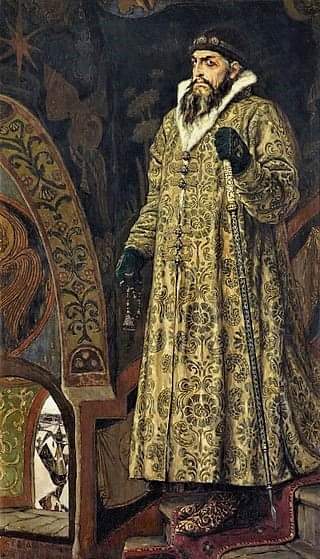
DEATH OF IVAN THE TERRIBLE
The grandson of Ivan the Great, Ivan was born Ivan Chetvyorty Vasilyevich on 25th August 1530, in the Grand Duchy of Muscovy, Russia.
His father, Basil III, died when he was 3 years old, from an abscess and inflammation on his leg, that developed into septicemia.
His mother, Elena Glinskaya, ruled as regent until her death in 1538, when Ivan was 8.
On 16th January 1547, 17 year old Ivan IV, was crowned the first Tsar of Russia at the Cathedral of the Dormition in Moscow.
By being crowned tsar, Ivan was sending a message to the world and to Russia, that he was now the only supreme ruler of the country, and his will was not to be questioned.
The court intrigue and constant danger that Ivan was exposed to while growing up, molded much of his ruthless and suspicious nature.
Evidence indicates that Ivan was a sensitive, intelligent boy, neglected and occasionally scorned by members of the nobility, who looked after him after his parents’ death.
The environment nurtured his hatred for the boyar class, whom he suspected of being involved in his mother’s death.
He developed a taste for literature and music.
Ivan IV, had a complex personality.
Intelligent yet prone to outbreaks of uncontrollable rage, Ivan’s tragic background contributed to his infamous behavior.
The same year Ivan became Tsar, he married Anastasia Romanovna, the first of his six wives.
It is widely believed that Anastasia had a calming influence on Ivan’s volatile character.
Anastasia had six children with Ivan, but only two survived to adulthood, both sons, Ivan Ivanovich and Feodor.
In the summer of 1560, Anastasia fell ill to a lingering illness and died on 7th August.
In consequence, Ivan suffered a severe emotional collapse, suspecting that his wife had been a victim of malicious actions and had been poisoned by the boyars.
Although he had no evidence of such crimes, he had a number of boyars tortured and ex3cuted.
The examination of Anastasia’s remains in the 1990’s and at the beginning of the 21st century by experts, provided evidence that could sustain her husband’s claim.
Further research confirmed the acute mercury poisoning of Anastasia.
While mercury was also used as a cure, leading to some debate around the issue, the found levels of mercury were too high, according to the experts, and thus the poisoning verdict remains the most accepted one today.
Over the next 24 years, Ivan IV conducted a reign of terror, displacing and destroying the major boyar families in the region.
It was also during this time that he created the Oprichniki, the first official secret Russian police force.
Ivan The Terrible’s constant warmongering, brutalising of his own population, attacks on the clergy, nobility and middle classes, the torturing and ex3cuting of anyone he felt was against him, and raiding of the nation’s wealth ~ eventually brought the Russian economy to its knees.
Things did not improve as Ivan aged, and his mental health deteriorated even further.
One of the last brutal acts of his reign occurred in 1581 when, upon encountering his heavily pregnant daughter-in-law in a state of undress, he beat her so severely that she miscarried.
On hearing the news of the loss of his unborn child, Ivan’s second son confronted his father.
Ivan, who always carried a sharpened baton around which he used to to beat anyone who displeased him, hit his son over the head so hard that he collapsed and died several days later.
In 1584, with his health failing, Ivan became obsessed with death, calling upon witches and soothsayers to sustain him, but to no avail.
Ivan’s reign of terror, came to an end on 28th March 1584.
Ivan died from a stroke while playing chess with a close friend, at the age of fifty-three.
His kingdom passed to his middle son, a feeble-minded man called Feodor who died childless in 1598.
This plunged Russia into a period of lawlessness and anarchy that came to be known as the ‘Time of Troubles’ and leading to the establishment of the Romanov Dynasty.
In 1963, the graves of Ivan and his sons were excavated and examined by scientists.
Chemical and structural analysis of his remains disproved earlier suggestions that Ivan suffered from syphilis, or that he was poisoned by arsenic or strangled.
At the time of his death, he was 5 ft. 10″ and weighed 85–90 kg.
Researchers concluded that Ivan was athletically built in his youth, but in his last year, had developed various bone diseases and could barely move.
They attributed the high mercury content in his body, to his use of ointments to heal his joints, and not for the treatment of syphilis.
? Portrait of Ivan IV by Viktor Vasnetsov, c.1897
Tretyakov Gallery, Moscow
About The Author


