
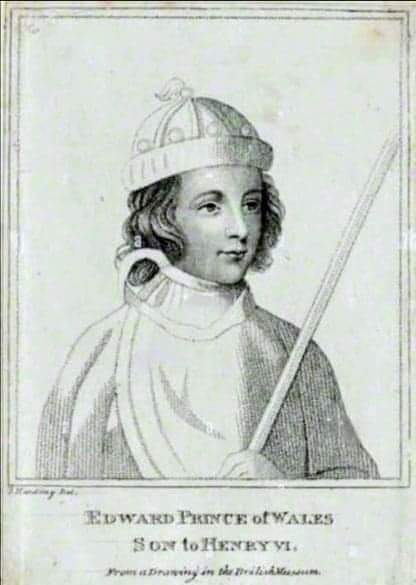
Death of Edward of Westminster
To be a prince in the Middle Ages meant you were born into a life of luxury and power.
However, along with this privilege came many duties and responsibilities.
A royal prince was trained in warfare from an early age and was expected to lead his army into battle.
A prince would also learn statecraft and diplomacy and was expected to run the domestic affairs of the country, as well as build alliances with foreign powers.
His marriage was an affair of state, not a personal choice made from love.
His choice of bride could either strengthen or weaken the country.
If the prince was an only child, he was doubly valuable.
For if he died, the hopes of his parents died with him.
One such prince, was Edward of Westminster.
Edward of Westminster, or Edward of Lancaster, as he is sometimes known, was a long-awaited child.
He was born in the Palace of Westminster on 13th October 1453, eight years after his parent’s marriage in 1445.
He was the only son of King Henry VI and Queen Margaret of Anjou.
Edward spent most of his life in his mother’s company.
Edward’s father, Henry VI was a weak king.
He was religious, uninterested in the affairs of the realm and suffered from bouts of mental confusion.
Henry VI’s failings as a monarch made it easier for his Yorkist rivals to challenge his rule.
Prior to Edward’s birth, by means of a “sudden fright,” Henry VI entered into a trance-like state, recognising no one.
Catatonic schizophrenia or depressive stupor have been suggested as a likely diagnosis.
The royal custom at the time, was that a prince could not be named as heir to the throne until his father acknowledged him and presented him to the peers of the realm.
To break this impasse the infant was taken to Windsor in the hope that seeing his child would snap the king out of his dazed condition.
It did not work.
Henry VI’s incapacity lasted from 1453 to 1454, and during this time Richard Plantagenet, Duke of York was named Lord Protector.
There were widespread rumours that Edward was the result of an affair between Queen Margaret and one of her loyal supporters.
Edmund Beaufort – 1st Duke of Somerset, and James Butler – Earl of Wiltshire were both suspected of fathering Prince Edward.
However, there is no firm evidence to support these rumours.
These were most likely fabricated by the Yorkist faction, that the child could not possibly be the feeble-minded king’s.
When Henry VI recovered his senses and was shown his son, he declared himself pleased.
Henry VI declared that Edward must have been fathered by the Holy Ghost.
This only added to the already existing doubts about the child’s paternity.
Edward of Lancaster’s claims to be heir to the throne were finally held up by Parliament on 15th March 1454, when he was given the titles of Prince of Wales and Earl of Chester.
In 1460, King Henry was captured by the Yorkists at the Battle of Northampton, and taken to London as their prisoner.
The Duke of York was appointed Protector of England. However, Margaret of Anjou – true to character – was not going to accept this meekly.
The queen was an entirely different character to her husband.
She was strong minded, arrogant and determined to keep hold of the reins of power to ensure her son became the next King of England.
Margaret gathered an army to advance her son’s cause and York, Salisbury and Warwick were forced to flee before her.
When York returned from exile, he laid a formal claim to the throne.
A compromise was agreed on, whereupon by the Act of Accord, Henry VI was to keep the throne for the remainder of his life, but the succession was to go to York and his heirs.
No one for a moment expected that the spirited Margaret of Anjou would accept the disinheriting of her son.
This proved to be the case.
Margaret and her son Edward meanwhile, fled to Cheshire.
Margaret recruited outlaws and pillagers to aid her, by asking them to pledge themselves to the seven-year-old Edward, as the rightful heir to the crown.
They subsequently reached safety in Wales and travelled on to refuge in Scotland, where Margaret raised support for her son’s cause.
By this age Edward of Westminster should have had his own household, spending his time with his tutors and learning the arts of war ~ rather than being dragged around the country by his mother, knowing his father was in the hands of his sworn enemies.
Maybe because of his youth, he was not told everything, but he would have picked up the atmosphere from the adults around him, and would know enough to feel insecure and fearful of the future.
One of the stories spread around was that Edward of Westminster was a cruel and vicious young prince.
A tradition from the 2nd Battle of St Albans is that two Yorkists called William Bonville and Sir Thomas Kyriell were captured.
After the battle, his mother asked Prince Edward, who was still only seven at this time, what he thought should be done with the two knights ~ and he promptly replied they should be b~headed!
After the Duke of York was slain at the Battle of Wakefield, the large army which Margaret had gathered advanced south.
They defeated the army of Richard Neville, Earl of Warwick, at the Second Battle of St Albans.
Warwick had brought the captive King Henry with him to this battle, and King Henry was found abandoned, wandering on the battlefield.
Margaret advanced on London but the Londoners, alarmed by news of the Lancastrian army’s pillaging, refused to admit her and she angrily retreated.
York’s son, the future Edward IV, defeated the Lancastrian army at Towton a few weeks later, in a bitter blood bath.
Margaret and Edward fled to Scotland again.
They remained there for three years, before they were forced to set sail to France.
Margaret and Edward maintained a court while they were in exile in France.
It was during these years in France when Edward’s bloodthirsty reputation really began to take shape.
Edward often delighted in attacking and assaulting the young companions attending him, sometimes with a lance, sometimes with a sword, sometimes with other weapons, in a warlike manner.
The years in France were Edward’s formative, teenage years. Encouraged by a doting mother and with an absent, weak father, he had no strong male influence to curb his excesses.
After several years in exile, a major rift between Edward and his ally, the powerful Richard Neville, known as ‘Warwick the Kingmaker’ forced Warwick to flee to France.
The discontented Warwick reconciled with the Lancastrian queen.
No mean feat, since they were bitter enemies as Margaret had ex3cuted Warwick’s father.
Warwick is reported to have spent hours on his knees before Margaret would consent to the alliance.
Warwick’s younger daughter Anne Neville was formally betrothed to Edward.
Edward officially married Anne at Angers Cathedral, probably on 13th December 1470.
Warwick duly invaded England on Margaret’s behalf in 1470, resulting in the flight of Edward IV to Burgundy.
Henry VI was released from the Tower of London – and briefly reinstated as king.
A sad and pitiful figure, King Henry was paraded through the streets of London in a shabby blue gown.
Margaret and Edward then set sail for England on 24th March 1470.
They landed the day the Battle of Barnet was fought, to learn the disastrous news of Warwick’s defeat and death.
Margaret marched her forces with Prince Edward leading, to join with the Lancastrians in Wales.
These were led by Jasper Tudor, the half-brother of Henry VI.
On 4th May, a very hot day, the weary Lancastrian forces faced the army of Edward IV at The battle of Tewkesbury.
It was destined to be Edward of Westminster’s first and last battle.
Eighteen-year-old Edward was killed either in the resulting battle, or during its aftermath.
There are several conflicting versions concerning how Prince Edward met his end.
One source states he was cut down as he fled north in the aftermath of the battle.
Another source states that following the rout of the Lancastrians, a small contingent of men found Edward hiding near a grove, where he was immediately b-headed on a makeshift block.
Others say that he was taken prisoner by George Duke of Clarence, and b~headed, despite appealing for mercy.
The version favoured by William Shakespeare, was that the captured prince was taken to Edward IV who asked him why he had rebelled.
Edward of Westminster proudly proclaimed, ‘I have come to claim my father’s heritage’.
Edward IV then struck him in the face with his gauntlet, which was the signal for the Duke of Clarence, the Duke of Gloucester and William, Lord Hastings to cut him down with their swords.
Some also said he was killed by Richard of Gloucester, as he had long wanted to make Anne Neville his wife.
However, it happened the short life of this unhappy prince was over.
Edward’s body was buried at Tewkesbury Abbey, and is now largely forgotten by history.
Queen Margaret, defeated at last by the death of the son she had fought so long and hard for, was taken captive at the end of the battle and imprisoned.
Edward’s widow, Anne Neville, was remarried to Edward IV’s youngest brother, Richard, Duke of Gloucester, the future Richard III.
About The Author


