
CLEOPATRA’S SNAKE, ALEXANDER’S NOSE
On 2 September 31 BC, the two fleets clashed. When the armies massed in Greece, Antony was outmanoeuvred by Octavian’s general Marcus Agrippa, who blockaded the Antonian army and fleet at Actium. Antony’s fleet featured multi-rower ships, quinqueremes, octeres and even giant deceres, but he was less good on the detail. At their war council, Cleopatra, commanding her feet of 200, voted to break out of Actium, but in battle their coordination was disastrous.
Cleopatra fled back to Alexandria with sixty ships, planning to use her Red Sea fleet to escape to her trading posts in Arabia if not India, only for the Arab king Malik to burn her ships. When Antony sailed after her, Octavian marched through Syria, negotiating secretly with Cleopatra, who offered to abdicate providing her children, especially Caesarion, kept their crowns. It is not clear if she really welcomed the defeated Antony.
She negotiated with Octavian, setting up headquarters in her mausoleum within the palace. Antony was possibly betrayed by Cleopatra, who misinformed him that she was dead, clearly a signal to commit suicide.
After stabbing himself with his sword, he was borne to her tomb where he died in her arms aged fifty-two. Allowing her to reside in the palace, Octavian took her three Antonian children into custody. When they met, she learned there was no third act: Octavian would display her in his triumph. ‘I will not be triumphed over,’ she told him – she had seen her sister Arsinoe paraded through Rome – but concealed her plans.
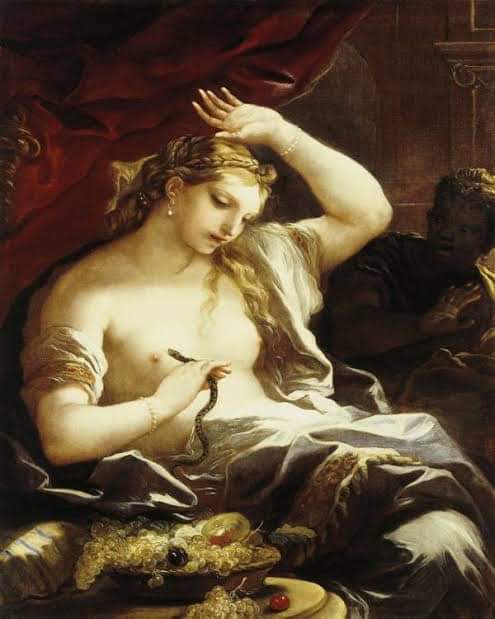
After feasting in style, her devoted attendants Eiras and Charmian arranged for a peasant to bring a basket of figs, containing a snake or at least a poison which all three of them somehow imbibed. She sent a sealed letter to Octavian asking to be buried with Antony, at which his guards rushed to stop her – too late.
Cleopatra, at the age of thirty-nine, laid out in her glory wearing her diadem, was dead, along with her ladies-in-waiting. One was still just alive when Octavian’s troops burst in and saw Cleopatra in her final magnificence: ‘What a majestic scene!’
‘Extremely,’ the girl murmured, ‘as becomes the descendant of so many kings.’
Cleopatra had hoped that Caesarion would rule Egypt. ‘Too many Caesars, warned Octavian’s advisers, ‘is not good.’
Cleopatra had sent King Caesarion, seventeen years old, with his tutor down to the Red Sea port of Berenice to escape to India, but Octavian tricked the tutor into bringing him back, hinting that the boy could rule Egypt – and then had him strangled.
Octavian visited the tomb of Alexander, but when he touched the mummy, he knocked off its nose – a moment that marked the end of the Alexandrian age, the fall of the Roman Republic and the launch of an imperial monarchy.
Source ~ The World A Famous History ~ Simon Sebag Montefiore
About The Author


