
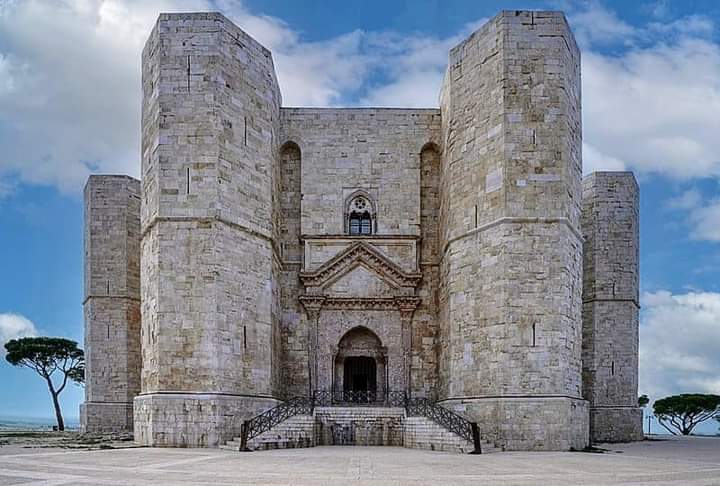
Castel del Monte – Puglia, Italy
Mysterious and perfectly octagonal, the Castel del Monte is one of southern Italy’s most talked-about landmarks.
No one knows why Frederick II built it – there’s no nearby town or strategic crossroads.
It was not built to defend anything, as it has no moat or drawbridge, no arrow slits, and no trapdoors for pouring boiling oil down onto marauding invaders.
Frederick II of Swabia, was one of the most fascinating figures in medieval history.
He is surrounded by an aura of mystery and the protagonist of many legends.
He was passionate about mathematics, poetry, philosophy and astronomy.
Frederick was gifted with a spirit that led him, as Emperor of the Holy Roman Empire first and King of Sicily later, to welcome Greek, Arab, Italian and Jewish scholars to his court.
During his reign, he had many castles built throughout southern Italy, but Castel del Monte is home to certain key aspects of the ruler and his passions.
Frederick inherited the land from his mother Constance of Sicily, and construction on Castel del Monte started in 1240.
Built with geometric and mathematical precision, it combines different stylistic and architectural elements.
This is evident in the Romanesque cut of the lions at the entrance to the Gothic frame of the towers, the classical art of the interior friezes, and the Islamic mosaics.
The castle has eight octagonal towers, full of symbols and mysteries.
Its interconnecting rooms have decorative marble columns and fireplaces, and the doorways and windows are framed in corallite stone.
Many of the towers have washing rooms with what are thought to be Europe’s first flushing loos – Frederick II set great store by cleanliness.
The octagonal layout gives Castel del Monte the configuration of an elegant stone crown, and is present in all the castle’s rooms.
There are eight rooms on the ground floor, and eight on the first floor.
The eight towers surrounding the building, all have an octagonal layout.
? This obsessive recurrence of the number eight, makes the fortress of Castel del Monte a place that has fascinated the best scholars for centuries.
This was obviously not built for defence.
So what was Castel del Monte built for then?
There are so many options –
Was it a temple?
A secluded place to study?
A place to relax or perhaps an astronomical observatory?
About The Author


