
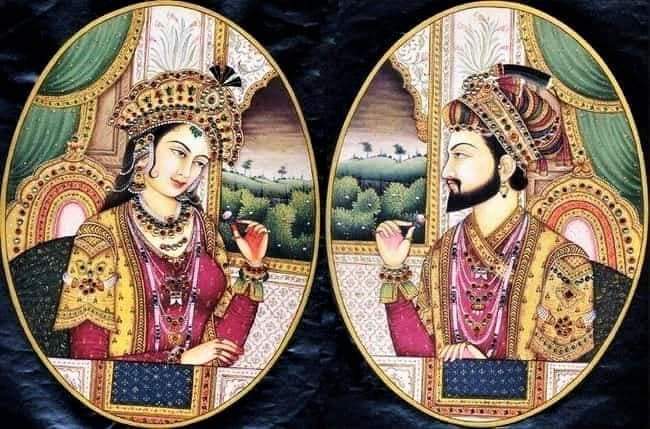
Birth of Mumtāz Mahal, Empress consort of Mughal Emperor Shah Jahan
Arjumand Banu Begum, popularly known as Mumtāz Mahal, was born on 27th April 1593.
Her father was a high-ranking Persian grand vizier, serving in the Mughal Empire.
Mumtāz was a lady of character and refinement.
She spoke Arabic and Persian very well, and could also write in these languages.
According to legend, Shah Jahan fell in love with Arjumand Banu Begum, at first sight.
The couple were married in 1612, when she was 14 years old and he was 15.
Although he already had another wife and later took a third, Arjumand was the love of his life.
He even gave her the name Mumtāz Mahal -“Jewel of the Palace”.
Shah Jahan’s relationship with his other wives, was nothing more than the status of marriage.
The intimacy, deep affection, attention and favour which Shah Jahan had for Mumtāz, exceeded a thousand times what he felt for any other woman.
Mumtāz had a very deep and loving marriage with Shah Jahan.
Even during her lifetime, poets would extol her beauty and gracefulness.
She was the Shah’s trusted companion and travelled all over the empire with him.
Mumtāz bore her husband fourteen children – including his most beloved daughter Jahanara Begum, and the crown prince Daru Shikoh.
In 1631, three years into Shah Jahan’s reign, a rebellion led by Khan Jahan Lodi was underway.
Shah Jahan took his military out to the Deccan, about 400 miles from Agra, in order to crush the usurper.
As usual, Mumtāz accompanied Shah Jahan, despite being heavily pregnant.
In an elaborately decorated tent, in the middle of the encampment, on 16th June 1631, Mumtāz gave birth to a healthy baby girl.
The birth had been difficult for Mumtāz, with her prolonged labour lasting around 30 hours.
At first, all seemed to be well, but then it became obvious that Mumtāz was dying.
The moment Shah Jahan received word of his wife’s condition, he rushed to her side.
Early in the morning on 17th June, just one day after the birth of their daughter, Mumtāz died in her husband’s arms.
Her devastated husband was determined to build the world’s most expensive mausoleum in Mumtāz memory.
It took 22 years and most of the money in the royal treasury, but the Taj Mahal was finally completed in 1653.
Masons, stonecutters, inlayers, carvers, painters, calligraphers, dome-builders and other artisans were requisitioned from the whole of the empire – and also from Central Asia and Iran.
An epitome of love – it made use of the services of 22,000 laborers and 1,000 elephants.
The monument was built entirely out of white marble, which was brought in from all over India and central Asia.
After an expenditure of approximately 32 million rupees, the Taj Mahal was complete.
An immense mausoleum of white marble – built in Agra, it is the jewel of Muslim art in India, and one of the universally admired masterpieces of the world’s heritage.
Standing majestically on the banks of River Yamuna, the Taj Mahal is synonymous of love and romance.
The name “Taj Mahal” was derived from the name of Mumtāz Mahal, and means “Crown Palace”.
About The Author


