
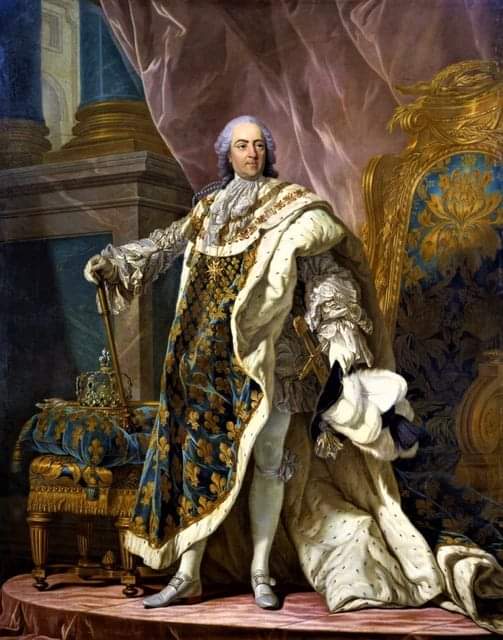
BIRTH OF LOUIS XV~KING OF FRANCE
Louis XV was born in the Palace of Versailles on 15th February 1710.
He was the son of the Duke of Burgundy and Marie Adélaïde of Savoy.
As the great-grandson of Louis XIV, Louis XV became heir apparent upon the death of his father in 1712.
He then became king in 1715 at just five years of age, upon the death of his grandfather.
Educated in natural sciences, botany, medicine, astronomy, geography and history, he took part in cabinet meetings from the age of ten.
In 1725 the young King married the Polish princess Maria Leszczyńska, who was seven years older than him.
The King and Queen went on to have ten children.
Of those, six daughters and one son, the Dauphin, survived to adulthood.
From 1732 onwards a series of mistresses played an important role in the king’s personal life.
The most notable of these official mistresses was Madame de Pompadour.
She played an important political role, first as royal mistress, then as friend and advisor to Louis XV.
In 1768, after the death of the Madame de Pompadour, Madame du Barry became the King’s official mistress.
She also lived at Versailles, in sumptuous, spacious apartments just above the King’s private apartments.
She remained at the King’s side until his death in 1774.
Louis XV died aged 64, on 10th May 1774.
His passing brought to an end a reign of 59 years, the longest in the history of France after that of Louis XIV.
Against all expectations, Louis “the Beloved” died an unpopular king.
On 26th April, the king went to the Petit Trianon with Madame Du Barry, and a few members of his close circle.
The following day he felt unwell when he woke, suffering aches and pains and a headache, but he nevertheless intended to keep to the planned hunting trip.
Still indisposed that evening, he went to bed without eating dinner.
Overnight, and through the next day his condition worsened.
On the 28th his Surgeon, was summoned, and ordered him to be moved to Versailles on the pretext that “Versailles is the best place in which to be ill”.
In his bedchamber, lying on a camp bed surrounded by a crowd of doctors and health specialists quarrelling over the diagnosis and treatment to apply, the first blood-letting was carried out on the morning of the 29th.
By 10.30 am, however, there was no longer any doubt: the king had smallpox.
Never having caught smallpox before, he had developed no immunity.
To avoid all risk of contagion the Royal family was kept away.
The king’s headaches continued, his fever grew hotter, and his body broke out in pustules.
By 1st May, his condition seemed stable.
Gradually, as pus was lanced from his body and face, the king improved.
On 8th May the disease reached a decisive stage, at which it could fall off or get worse…..but a sharp decline soon set in.
The king’s fever resumed, hotter than ever, and his pulse raced, he became delirious and the flow of pus began to dry up.
The doctors believed all was lost, and on the 9th his condition continued to decline.
The scabs and dry pimples turned black, and the ones on his throat prevented him from swallowing.
His Confessor was summoned, as well as his First Almoner, who administered extreme unction.
The king, whose face was blackened and distorted by the scabs, was given a final remedy, but with little hope of success.
On the morning of 10th May he lay motionless, though still conscious.
At 11 am he went into his death throes, and died at 3.15 pm.
Amidst cries of “Long live the King!”, the throng of courtiers rushed through the Hall of Mirrors to the Dauphin’s apartment on the ground floor.
Louis XVI and Marie-Antoinette knelt down, embracing each other, and murmured:
“My God, guide us and protect us; we are too young to ascend to the throne.”
The reign of Louis XVI had begun……
Portrait by Louis-Michel van Loo ~ 1760
About The Author


