
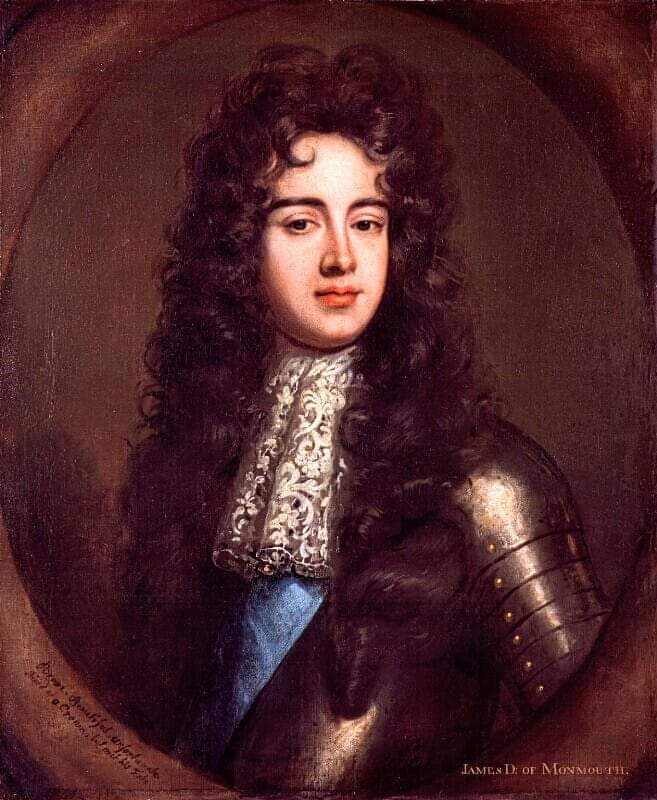
Birth of James Scott, 1st Duke of Monmouth and Buccleuch – illegitimate son of Charles II
James Scott was the first-born child of Charles II, by his mistress Lucy Walter.
He was born on 9th April 1649, in Rotterdam, in the Netherlands.
Charles had been exiled there the year before, and this was when he conducted his relationship with Lucy.
James Scott had a very turbulent and difficult childhood.
Before he was even born, Charles left the Netherlands for Scotland in an attempt to claim the Scottish and English thrones.
Then, when James was just a year old, he was kidnapped.
He was missing for ten days, and eventually found safe and well.
James’ mother Lucy, believed that Cromwell was behind the kidnapping of her little boy – in an attempt to remove James as a potential future threat to Cromwell’s new republican rule.
Charles and James saw little of each other for the first twelve years of James’ life.
Charles returned to exile in France in October 1651.
He made it clear that his relationship with Lucy was over.
Charles may have seen James during his time in Paris, but in July 1654, Charles moved to Germany for eighteen months.
While there, Charles attempted to gain funds and gather support for his cause.
In January 1656, Charles gave Lucy some money, and sent Lucy and James to England.
They lived in London for a few months until the Cromwellian government, anxious about her and James’ presence in London, arrested them, and threw them in the Tower of London.
Eventually they were shipped back to the Netherlands in July 1656.
Once they were back in Flanders, Charles decided to take his son into his custody.
In April 1658, one of Charles’ men managed to take James from his house, and went on the run with him for six months.
James was finally put into the care of Lord William Crofts, a trusted gentleman of Charles’ bedchamber.
In December 1658, James’ mother Lucy died.
James was just nine years old, and it had been a disturbing, fraught and potentially loveless start to his life.
This boy had been constantly moved around between countries, abandoned by his father, and used as a bargaining chip.
There was little regard for creating any stability in his life, his education or his needs as a child.
In 1660, Charles II was crowned king.
He sent for James to join him at the English court, and James arrived in England two years later.
Although they had not spent much time together, the twelve-year-old boy quickly won his father over, and Charles doted on him.
It’s possible that Charles may have felt more responsibility to the young James than his other children.
Given the way in which James was treated as a child, and the fact that his mother was now dead Charles may have felt remorse and guilt.
But, whatever the circumstances, the two soon formed a genuine close and loving bond.
Charles quickly began elevating James’ position. Arrangements were made for James to marry Anne Scott, Countess of Buccleuch, a wealthy Scottish heiress.
Anne’s father had long stipulated that any man who married his daughter would take the family name, so in preparation for the wedding, James changed his surname to Scott.
The marriage between the fourteen-year-old James and 12 year old Anne, took place on 20th April 1663.
The following day, the young couple were jointly made Duke and Duchess of Buccleuch.
James was also granted the titles of Duke of Monmouth, Earl of Doncaster, and Baron Scott of Tynedale, and given precedence over all dukes not of royal blood.
He was also nominated as a Knight of the Garter.
With James’ numerous titles and aristocratic marriage secured, King Charles then set about ensuring that James would have an income fit for the son of a king.
This rapid change in lifestyle, wealth, status and privilege quickly went to James’ young head.
Like his father, he was athletic and loved the outdoors, preferring hunting, fishing and racing, to actually doing any work.
Also like his father, James quickly embraced the debauchery of the court, by gambling, partying, drinking heavily and womanising.
James was living so extravagantly, that within just a few years of arriving at court, he ran up debts of £18,000.
James only seemed to care for frivolity and fun, and soon his reputation suffered.
When it came to women, James also followed in his father’s footsteps.
His relationship with his wife, Anne, was amicable but distant.
Although they had six children together, throughout their marriage James had a string of mistresses as well as more casual liaisons.
James also had a nasty, violent streak, perhaps due to his feeling invincible by virtue of being the apple of the king’s eye.
James reputation as a dashing and brave Protestant son of the king, “the Protestant Duke”, made him a celebrity.
King Charles clearly adored his son, and for several years the court chinwaggers were frantically whispering that Charles was sure to make James his heir.
This, of course, began to create division at court.
Many people were appalled that an illegitimate child would swoop in and undermine the rightful line of succession.
Others, who disapproved of the Catholicism of the king’s brother James Duke of York, were thrilled at the prospect of a young, Protestant heir.
In May 1679, Parliament proposed the ‘Exclusion Bill’ that would exclude all Catholics – including, of course, James Duke of York – from succeeding to the throne.
However, the bill did not become law as Charles had dissolved Parliament.
As James’ popularity increased and anti-Catholicism swept England, King Charles was forced to send his son into exile in September 1679.
Furious at being sent into exile while, James took it upon himself to return to England – without his father’s permission.
James slipped quietly into London on the night of 27th November, but his arrival didn’t remain a secret for long.
By dawn, bonfires were being lit in honour of his return.
King Charles was irate.
The next day he stripped his son of most of his offices and ordered him to go back into exile.
James refused.
King Charles was so angry, he refused to see his son.
King Charles II died in February 1685.
The moment dreaded by so many had come.
King Charles Catholic brother James II & VII, was now king.
There were already Scottish and English Protestants living in exile in the Low Countries, and soon a plot to overthrow King James was underway.
Within just a few months, the plans had been made and James recruited a rag-tag army of skirmishers, soldiers and locals, and led the campaign against the new king.
Unfortunately for James, the Rebellion was unsuccessful, and he was captured by King James II’s forces.
While being held in the Tower of London, James begged with his uncle to sparr his life.
King James refused his pleas, and James was found guilty of treason.
King James allowed him to see his children one last time, and agreed to a b-heading instead of hanging – a death more fit for a nobleman.
On 15th July 1685, James was led out to the scaffold at Tower Hill to be ex3cuted.
Before he knelt at the block, James begged the axeman Jack Ketch, to make the execution swift and to finish it in one blow.
Ketch had recently botched several ex3cutions, and James was allegedly worried that he would suffer the same fate.
Sure enough, according to several reports, Ketch took between five and eight strikes to James neck…
Some even said that Ketch had to finish off the job with a knife to sever James head from his body.
James’ remains were buried under the communion table at St Peter ad Vincula in the Tower of London.
? James Scott, Duke of Monmouth and Buccleuch, c.1683
After Willem Wissing
About The Author


