
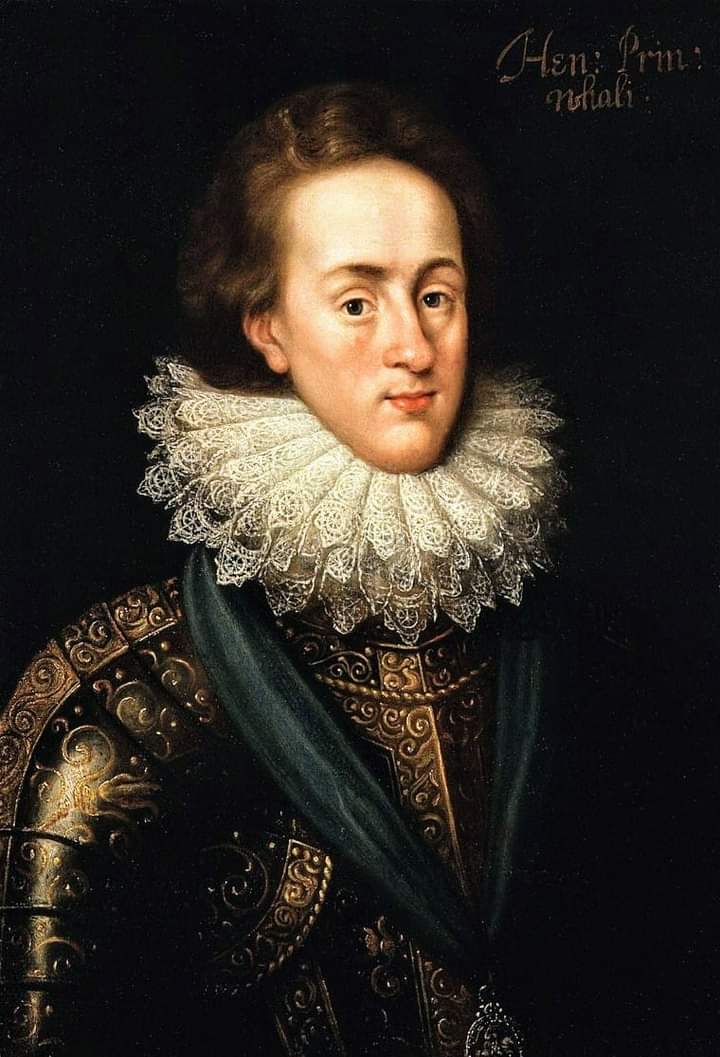
Birth of Henry Frederick Stuart
Henry Frederick Stuart was born at Stirling Castle on 19th February 1594.
He was the firstborn child of James VI of Scotland (later I of England) and Anne of Denmark.
He was named in honour of his two grandfathers, Henry Stuart, Lord Darnley and Frederick II of Denmark.
From birth, he became Duke of Rothesay, Earl of Carrick, Baron of Renfrew, Lord of the Isles and Prince and Great Steward of Scotland.
The young prince was placed in the care of John Erskine, Earl of Mar, as his father was concerned that his wife Anne of Denmark’s leanings toward Catholicism might affect their son.
When Henry’s siblings came along, Elizabeth Stuart and Charles ( the future Charles I ) they were also removed from their mother’s care.
This, understandably, led to tension between their parents.
Henry remained in the care of the Earl of Mar until 1603, when James VI of Scotland became King of England.
The family then moved south.
Henry automatically became Duke of Cornwall on his father’s accession to the English throne, and was invested Prince of Wales and Earl of Chester in 1610.
Henry didn’t always see eye to eye with his father. He disapproved of his father’s pleasure-loving court and the royal favourite Robert Carr, whom he actively disliked.
He was also against the imprisonment of Sir Walter Raleigh in the Tower of London, whom he held in great esteem.
As a young man, the would-be King Henry showed great promise, and was intelligent and athletic.
Described as an “obdurate Protestant”, when his father proposed a French marriage, Henry replied “two religions should not lie in my bed”
Prince Henry was extremely popular in England and often eclipsed his father.
Relations between father and son were often tense.
Henry often teased his nine-year-old younger brother Charles.
He informed him that when he became king he would make Charles Archbishop of Canterbury, so Charles would have a long robe to hide his rickety legs.
Henry was a keen collector of paintings, sculptures and books.
At the age of 16, he had already built up an art collection, which included drawings by Holbein.
These are now housed in the Windsor Castle library.
He also enjoyed music and literature and had an interest in architecture.
In 1611, King James gave Woodstock Palace in Oxfordshire to Prince Henry.
Henry had a banqueting house built of leafy tree branches in the park, in which he held a dinner for his parents and his sister Princess Elizabeth.
During the celebrations that led up to his sister Elizabeth’s wedding, Henry fell ill with a fever.
He didn’t recover.
Henry Stuart Prince of Wales, died from typhoid fever at the age of 18, on 6th November 1612.
It was reported that his last words were to ask for his sister, Princess Elizabeth.
Prince Henry’s early death was widely regarded as a tragedy for the nation.
Few heirs to the English throne had been as widely and deeply mourned as Prince Henry.
Henry’s body lay in state at St.James’s Palace for four weeks.
On 7th December 1612, over a thousand people walked in the mile-long cortege to Westminster Abbey to hear the two-hour sermon delivered by the Archbishop of Canterbury.
Prince Charles, the new heir to the throne, fell ill after Henry’s death, but attended the funeral as chief mourner.
As Henry’s body was lowered into the ground, his chief servants broke their staves of office at the grave.
Henry Prince of Wales c.1610.
After Isaac Oliver.
About The Author


