
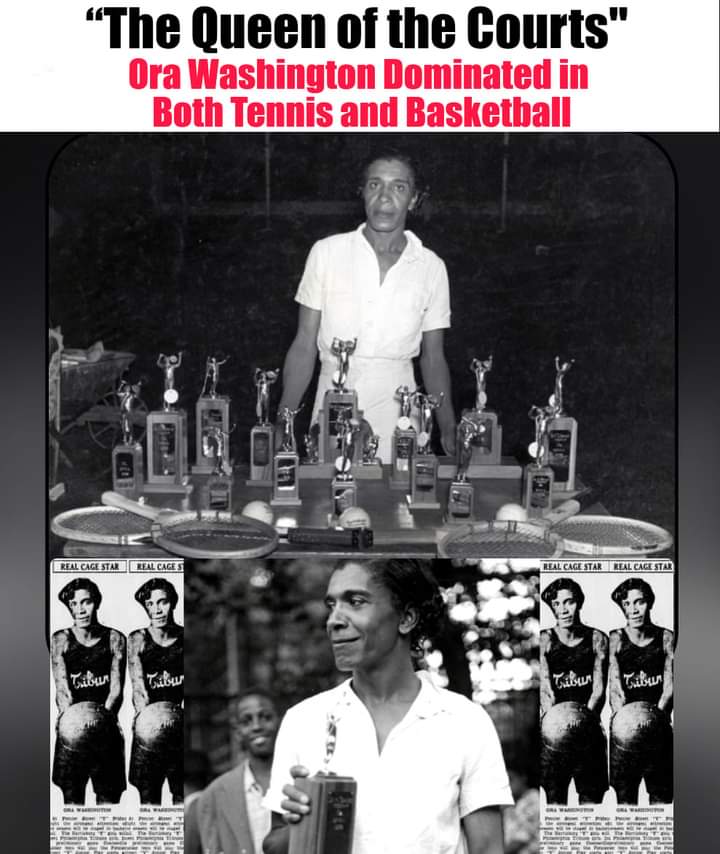
Ora Washington (1898-1971) is considered America’s first Black woman sports celebrity. Dubbed “The Queen of the Courts,” Washington dominated in both tennis and basketball. Most of her fans didn’t know that she accomplished all of this while working as a maid.
On the tennis court, Washington won 12-straight American Tennis Association doubles titles and nine-straight singles titles. The ATA was founded in 1916 after what is now the United States Tennis Association banned Black players from its competitions.
On the basketball court, Washington won 11 consecutive world titles and played for the Philadelphia Tribunes and Germantown Hornets. At 5’7, Washington played center, could shoot with both hands, got steals and was considered an all-around player.
Ora didn’t brag about her 23 national tennis titles or the dozen national championships she won in basketball. And she didn’t complain about the fact that she’d never been allowed to compete for a title in a sport that wasn’t racially segregated.
TENNIS
Ora found Germantown Y, known back then as the “colored YWCA.” She started playing tennis sometime in 1924, possibly as a distraction from grief over the death of her sister.
“She picks up a racquet, and all of a sudden everyone realizes she’s going to be really good,” historian Pamela Grundy says.
Just a year later, in 1925, Ora Washington won her first of 12-straight American Tennis Association national women’s doubles titles. Later, she’d win eight singles titles and three more in mixed doubles. Pamela found this one quote — it sums up Ora’s dominance on the tennis court.
“She was so intimidating, many of her opponents were beaten before the first ball passed over the net,” Pamela recalls.
Washington played against, trained with and mentored Althea Gibson, who is better known, in direct comparison, and who “broke the color line” in tennis and became the first African American to win a Grand Slam title in 1956 before winning Wimbledon and US Nationals in 1958 and 1959. Washington won her last title in 1947.
It wasn’t until 1950 that tennis officially became desegregated when Althea Gibson played in the USLTA National Championships.
At the height of her talents, however, the one match she ached to play was denied her. From the mid 1920s through the early 1930s, Helen Wills Moody conquered the prestigious white worlds of Wimbledon and Forest Hills with much the same thoroughness as Washington had the black equivalents. But she refused to play Washington. Their match remains one of tennis’s most tantalizing might-have-beens.
Still, Washington’s achievement did not go unnoticed. Her success encouraged the Roosevelt administration, as part of Depression-era work and recovery programs, to build hundreds of public tennis courts in urban areas where the game was unfamiliar. Future champions like Author Ashe and Althea Gibson, the first black man and woman to win Wimbledon and the U.S. Open, would learn the game on those courts.
Tennis great Arthur Ashe described her as “the first Black female to dominate a sport”.
BASKETBALL
She picked up the game of basketball in the fall of 1930, playing for the Germantown Hornets, a team sponsored by the Y. Basketball, like tennis, was segregated, and the team with the best record in the country at the end of the season was declared the National Champion. In 1931, that team was the 21–1 Germantown Hornets.
“They actually end up breaking away from the YWCA the next year,” Pamela says. “And they form a little semi-pro team.”
The Hornets’ success caught the attention of the Philadelphia Tribune, which, starting in the fall of 1931, sponsored its own team, the Tribune Girls. The next year, the Tribunes hired Ora Washington away from the Hornets. The paper ran ads in support of its dream team.
Over the next 12 years, Ora and the Tribune Girls barnstormed up and down the east coast, through the South and the Midwest. The team had no rivals, and Ora was their star.
HONORS
She entered the Black Athletes Hall of Fame in 1976, was enshrined in the Temple Sports Hall of Fame in 1986, Women’s Basketball Hall of Fame and Black Tennis Hall of Fame in 2009, and the Naismith Hall of Fame in 2018.
Washington was presented into the Naismith in 2018 by fellow Philly legend Dawn Staley, in the same class as Tina Thompson.
Washington passed away in 1971; there was a Philadelphia Tribune obituary, but most of the sports world hadn’t known. She was almost completely unknown outside the African-American community, and even there, the woman who helped pave the way for such future champions as Althea Gibson, and Venus and Serena Williams was largely forgotten.
About The Author


