
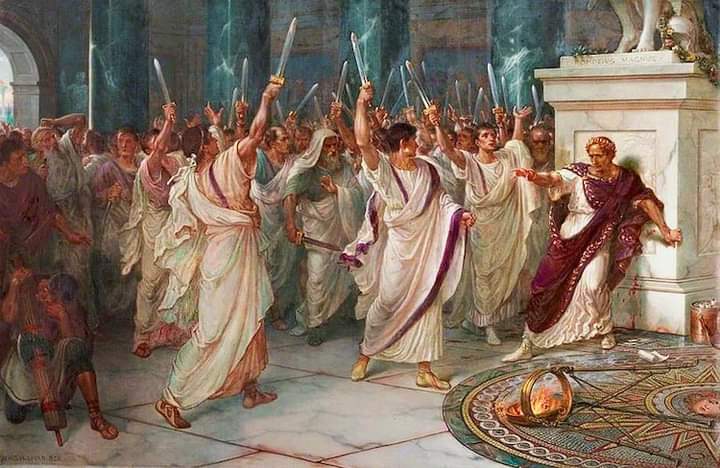
Assassination of Julius Caesar
Beware The Ides Of March!!
‘The Ides of March’ is arguably the most well known date in ancient history.
Julius Caesar was a Roman general, a statesman and was an integral character in Rome moving from a republic to an empire.
Fearful of Caesar’s power and domination of the state, a group of senators led by Brutus and Cassius, assassinated Caesar on the Ides of March ~ 15th March 44 BC.
On the afternoon of 15th March, the Roman dictator Julius Caesar entered the Senate meeting room, where he met his doom.
Marc Antony, Caesar’s right-hand man, did not accompany Caesar into the meeting.
Marc Antony had intended to be at the meeting, but outside, he was pulled aside to discuss some pressing matters.
Caesar would enter the meeting room, and be greeted by a murderous coup.
Before long, he would be dead.
Interestingly, some of the conspirators had wanted to kill Marc Antony along with Caesar at the senate meeting.
Marcus Brutus convinced them not to.
Their sole aim was to kill Caesar, to free Rome from a tyrant.
To murder the man whose power and position were eroding the ideas of the Republic.
Marc Antony was a problem for another day….
With Marc Antony preoccupied, Caesar entered the meeting room.
Straight away, he headed for his gilded chair.
The senators rose to greet Caesar as he walked in the room.
In total, the senators present numbered a few hundred.
Most were not expecting anything out of the ordinary to happen before the meeting commenced.
For those 30-80 senators involved in the conspiracy, the time had come.
They had arrived early, they had watched as Caesar entered the room, their daggers hidden within the folds of their togas.
The moment of the assassination was nearly at hand.
A senator approached Caesar.
His name was Tillius Cimber.
Cimber had supported Caesar in the preceding civil war, but since then relations between the two had soured.
Especially after Caesar had exiled Cimber’s brother.
As soon as Caesar had seated himself on his ornate chair, Cimber walked up to the dictator, threw himself to his knees and asked Caesar for clemency, on behalf of his exiled brother.
Caesar shrugged off Cimber’s plea, telling the senator that he would consider the issue.
Standing up, Cimber grabbed hold of Caesar’s toga, shocking the seated dictator, and many of those surrounding them.
His grabbing of Caesar’s toga, was the agreed upon signal for the assassination to begin.
The first assassin Publius Casca, stepped forwards.
Casca had positioned himself directly behind Caesar and his gilded chair, centimetres from the seated tyrant.
With Cimber holding Caesar down, Casca took out his dagger from the folds of his toga, raised his weapon and aimed for Caesar’s neck.
Casca missed, and rather than stab Caesar in the neck, Casca drove his dagger into Caesar’s shoulder.
Immediately, Caesar leapt up and reacted to Casca’s blow.
By this point, the meeting room had descended into pandemonium.
Marcus Brutus was among the wounded, having been accidentally struck on the hand by Cassius as the latter tried to land a blow on Caesar.
Those senators not involved in the plot watched on in panic and soon started to flee.
Only two senators attempted to aid Caesar, but their efforts proved fruitless.
Soon they too were forced to abandon Caesar, and flee to safety.
Dagger after dagger punctured Caesar’s body, his toga was smeared with his own, very mortal, blood.
The dying dictator ultimately fell to the ground, having received more than twenty stab wounds.
Before he breathed his last, Caesar caught sight of Marcus Brutus, standing among the ranks of the conspirators.
Once Caesar saw Marcus about to deliver his final blow, he said the Greek words:
Kai su teknon
‘You too my child?’
? The assassination of Julius Caesar, painted by William Holmes Sullivan, c. 1888
About The Author


