
John Fian Burned For Witchcraft
John Fian was the central figure in Scotland’s most famous witch trials.
Schoolmaster Fian, also known as John Cunningham, was accused of leading a Coven of witches in North Berwick who, among other charges, attempted to assassinate King James VI/I.
Fian was brutally tortured until he confessed and was burned at the stake on 27th January 1591.
The downfall of Fian was brought about by a young servant girl named Gillis Duncan, whose gift for natural healing was suspected as the Devil’s Magic.
Under torture, she accused several persons of witchcraft, including Fian.
Fian, who had a reputation as a conjurer, was arrested on 20th December 1590, and charged with 20 counts of witchcraft and high treason.
The most important charge was that of the attempted murder of King James as he sailed to Denmark to fetch his bride-to-be.
The witches allegedly raised a terrible storm at sea ~ by tossing a charm of a dead cat with human limbs tied to its paws, into the ocean and crying “Hola!”
On the return voyage, Satan then cast a “thing like a football” into the sea, raising a mist.
The king’s ship was battered about, but returned safely with no casualties.
Other charges against Fian included acting as secretary at the coven meetings, at which he recorded the oaths of allegiance to Satan.
He was accused of performing ‘The Kiss Of Shame’ ~ kissing the Devil’s anus.
He was also charged with making a Devil’s pact, falling into ecstasies and trances, and bewitching a man to have a spell of lunacy once every 24 hours – because he loved the same woman as Fian.
Another charge against him was attempting to seduce a woman by bewitching her, but instead he bewitched a heifer that followed him about “leaping and dancing”
Accusations of grave robbing for body parts to use as charms, and various acts of magic, such as flying through the air.
He was also accused of putting magical candles on the legs of his horse, which enabled him to turn night into day, as he rode.
Upon his arrest, Fian was imprisoned.
He refused to confess and was subjected to severe torture.
After having his head “thrawed” with a rope (bound and twisted in various directions), he still denied the charges.
Fian was then given a torture described as “the most severe and cruell paine in the world,” the “boots,”
The boots were a device that went around the legs from knee to ankle, and was progressively tightened with blows from a hammer.
Fian was given three hammer blows while in the boots, and passed out.
His torturers “found” two pins under his tongue.
The court declared that the pins were a witch’s charm to prevent him from confessing.
Fian was released from the boots and taken before King James.
Broken, he confessed in his own writing.
He renounced the Devil and vowed to lead the life of a Christian.
He was taken back to jail.
The following day, the jailors found Fian greatly distressed.
He said the Devil had appeared before him in the night, dressed in black and carrying a white wand, and had demanded that he continue his service in accordance with his pact.
The Devil reminded him that he would possess Fian’s soul upon death.
Fian was brought again before King James.
He then recanted his confession.
James was convinced that Fian had entered into a new pact with the Devil.
He had Fian’s body searched for a new Devil’s mark, but none could be found.
Determined to get another confession out of the schoolmaster, James ordered more brutal torture.
His nails were pulled from his fingers, and under each nail, two needles were thrust into his skin.
Fian still would not confess.
He was again placed in the boots, where his feet and legs were so crushed, that blood and marrow gushed from his wounds.
Fian still would not confess, “so deeply had the Devil entered into his heart.”
The enraged king nevertheless condemned him to die.
Fian was put into a cart and taken to Castle Hill in Edinburgh, where a great bonfire was prepared.
On Saturday 27th January, 1591, he was strangled and thrown immediately into the flames.
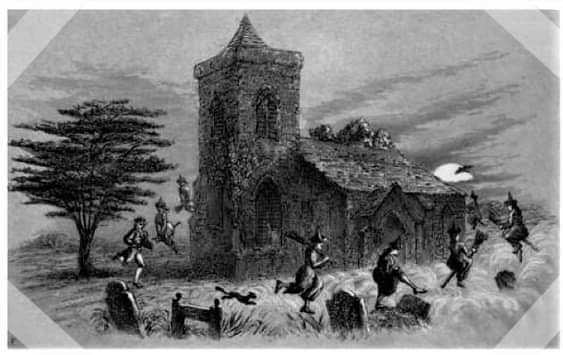
Illustration of John Fian and his coven, flying around the church in North Berwick.
About The Author


