
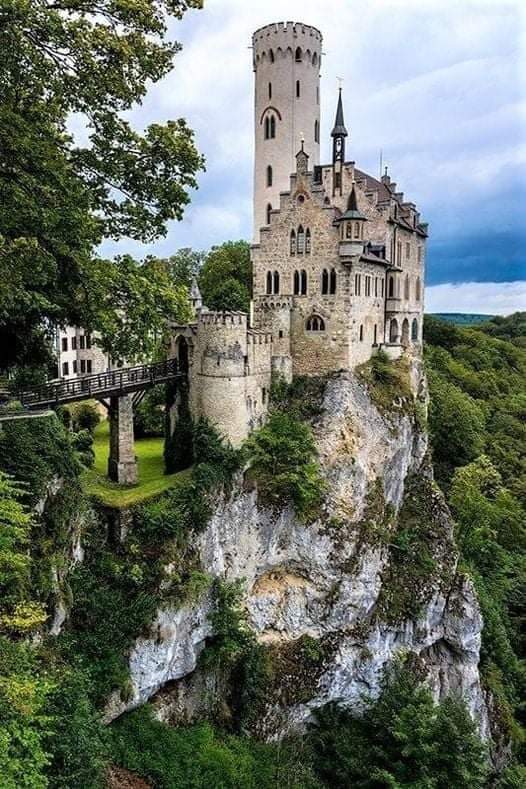
LICHTENSTEIN CASTLE
Perched on an 800 meters-high cliff just on the edge of the Swabian Alps, Lichtenstein Castle was a romantic castle, built by Count Wilhelm of Württemberg.
At the beginning of the 12th century, the Lords of Lichtenstein – a respectable and noble family – owned much of the land and controlled important resources in the region.
Their ancestral seat was a small fortress that was built above the source of the river Echaz, directly above the present castle.
Unfortunately for them, their fortress was under constant attack from the citizens of the Free Imperial City of Reutlingen.
After the second siege, the Lords of Lichtenstein decided to build a new and better-equipped fortress able to withstand the numerous attacks.
The new Lichtenstein Fortress was erected about 500 meters away from the old castle.
Completed in 1390, the new castle was one of the most impressive fortifications of the Late Middle Ages.
Incorporating modern military features such as early casemates, the new fortress was virtually impregnable and it withstood every single attack.
In 1567, however, the castle lost its status as ducal seat and as a consequence it began to fall into disrepair.
In 1687, the last member of the Lichtenstein family died fighting in the Great Turkish War and the castle was taken over by the Tyrolean line of the Habsburg family.
The coat of arms of the Lichtenstein family – a pair of golden angel wings on a blue background – is still displayed in the Great Hall of the castle.
Over the next century, the castle continued to deteriorate until it finally came into the possession of King Frederick I of Württemberg.
In 1802, he decided to dismantle the entire structure and replace it with a hunting lodge.
In 1826, German poet and novelist Wilhelm Hauff published his historical novel “Lichtenstein”.
The novel is set in and around Württemberg, with the castle of Lichtenstein playing a major role.
The book was a huge success.
Count Wilhelm von Urach, who was the cousin of King Wilhelm of Württemberg, was so inspired by the book, and extremely interested in medieval history and architecture, he decided to buy and remodel the castle.
He was a great art-lover, and was looking to house his substantial collection of medieval arts, arms and armour in a setting that would compliment them.
His cousin agreed on the sale, Wilhelm started immediately on his project.
The whole reconstruction was heavily influenced by Count Wilhelm himself, according to contemporary accounts, he was the heart and soul behind the entire process.
The structure used the ancient foundations of the castle of 1390 and stood up to three stories tall.
A courtyard and a curtain wall together with several adjoining buildings and facilities completed the complex.
In 1857, a barbican and an outer bailey were added to the construction.
Count Wilhelm furnished the rooms of the castle himself.
The castle was decorated by a Nuremberg painter who was responsible for the inner as well as for the outer ornamentations.
The Romantic neo-Gothic castle was inaugurated in 1842 with the King present at the ceremony.
In 1869, it became the official residence of the Dukes of Urach.
After the Revolution of 1848, Count Wilhelm became the first Duke of Urach.
He decided to improve the castle’s defenses.
A trench along the fortress was constructed to deter attacks.
Later, cannons were placed in the bastions on the walls.
The final two buildings of the present structure, the Ducal Palace and the old groundskeeper’s house, were completed in 1901.
During World War II, an American tank passing through the valley below fired a shell, which directly hit the main tower.
Fortunately, the shell failed to explode, saving the great building from destruction.
However, a hole in the plaster where the shell struck remains to this day.
After 1980, the castle was restored to it’s present appearance.
The tower and outer walls were restored in 1980, followed by the second floor along with other valuable historical objects.
The upper floors and the roof were restored in 2002.
Today, the castle is still owned by the Dukes of Urach and it is open for visitors via guided tours.
About The Author


