
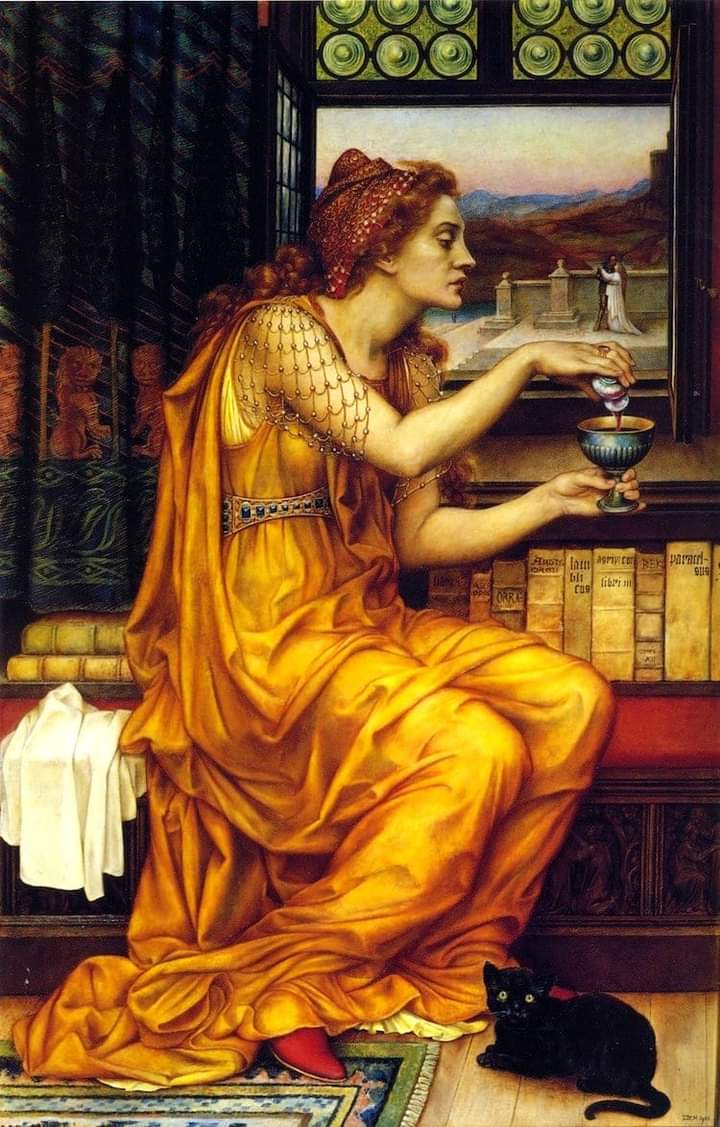
The Love Potion
Death, Poison & Witchcraft at Versailles
Beneath the gilt and glamor of King Louis XIV’s palace at Versailles, wafted a terrible smell….
A lack of facilities led some courtiers to defecate around the palace and grounds with abandon.
The few bathrooms they had, were poorly maintained and often overflowing with waste.
However, there was another more sinister stench discernible there as well.
One more troubling than the commonplace stink of humanity.
The unmistakable stench of death…..
In the late 1660s and early 1670s, influential members of the French nobility began to die – unexpectedly and close in frequency.
Autopsies showed their insides blackened and corroded.
A lust for poisoning and witchcraft seemed to have infected the court.
In 1679 Louis XIV was forced to establish a special tribunal, a Chambre Ardente, or “burning room” to investigate and prosecute the murders.
The “Affair of the Poisons,” as it came to be known, is a misleading name for one of the largest witch trials in modern history.
From 1677 to 1682, 364 people were questioned, 194 were arrested, and 36 ex3cuted – with perhaps dozens more dead from suicide, or in prison or exiled.
It all began with what appeared to be an isolated case, but then door after door after door opened, eventually implicating the rich and poor alike.
‘The Affair’ was confusing, complex, and persistent.
Everyone, however powerful, had a common fear of witchcraft, poisoning, and the unknown.
Fortune-telling and palm-reading joined gambling as popular court activities, against a backdrop of superstition and belief in witchcraft.
Murder, in this setting, could be just another diversion.
This diversion didn’t involve blades and blood, but poison….
In 1672, French police were called to investigate a break-in at a laboratory belonging to one Gaudin de Sainte-Croix, a devilishly handsome, and recently deceased, young army officer.
There, they found a red leather trunk of letters, vials, and mysterious substances.
The contents of the trunk seemed to link Sainte-Croix’s two passions – his lover, the very married Marie de Brinvilliers, and poisoning.
Sainte-Croix and de Brinvilliers shared their passions, and began to test this new substance, likely arsenic, by lacing cakes and other sweets with it.
They would then give them to unsuspecting patients in a nearby public hospital.
Seemingly, the thrill was their only motive.
Letters in the trunk, implicated de Brinvilliers in the recent deaths of her father and two brothers aswell.
Upon the discovery of the trunk, de Brinvilliers fled Paris for the countryside and then abroad.
She managed to remain on the run for four years, but was finally arrested in Belgium.
Marie de Brinvilliers was found guilty and subjected to “water torture” to force her to name her accomplices.
Stripped naked and bound, she had 24 pints of water forced down her throat.
She was then b3headed and burned at the stake, her ashes cast into the wind.
Just before she died, de Brinvilliers said,
“Out of so many guilty people, must I be the only one to be put to death?
Half the people in town are involved in this thing, and I could ruin them if I were to talk.”
Indeed, Paris was about to go mad.
So many of the superstitious citizens of Paris had inhaled de Brinvilliers’s wicked ashes, as she burned
“With such evil little spirits in the air, who knows what poisonous humor may overcome us”
Indeed, over the next seven years, dozens of nobles would perish, either by torture, suicide, ex3cution, or poison.
An alarmed King Louis XIV, appointed Gabriel Nicolas de la Reynie, Lieutenant General of the Paris Police, to oversee an investigation.
It was not long before arrests began.
Police descended upon alchemists, counterfeiters, and poisoners, amid rumors of a royal poisoning plot.
‘The Affair’ was about poison, to be sure, but it was also about witchcraft.
The two were constant bedfellows.
Lieutenant La Reynie made a hugely important arrest, that gave him the rattling keys to Paris’ criminal underworld.
Police uncovered troves of lethal chemicals ~ arsenic, nitric acid, mercuric chloride, equipment, furnaces, forceps, cauldrons, vials, and foul natural ingredients ~ flowers, deadly nightshade, blobs of hanged-man’s fat, nail clippings, bone splinters, specimens of human blood, excrement, urine, and semen.
These belonged to Catherine Monvoisin, also known as La Voisin.
By profession, La Voisin was something between a fortune-teller, and an amateur apothecary.
La Voisin was also a practitioner of some repute, allegedly known to virtually every woman in Paris.
La Voisin found that she was often visited by women with the problem of an illegitimate child on the way.
Abortion was illegal in France at the time, of course, leaving women no option but to turn to shady characters like La Voisin, for assistance.
Sometimes she gave them an abortion, sometimes she would deliver the child for them and then have it secretly adopted or otherwise ‘dealt with’.
Either way, her discretion in these matters was probably a major factor in how she began to get more and more high-profile clients, including several from the nobility.
Adultery was illegal for all, but carried no penalty for men.
Women, however, could face imprisonment, beatings, or loss of dowry for sullying a husband’s honour and the legitimacy of his heirs.
So women, it appears, turned to poisons to liberate themselves from unwanted pregnancies, lovers – or husbands.
These potions often had uterine origins such as menstrual blood or placenta, as if to liberate their users from the bindings of womanhood.
La Voisin, was apprehended outside her parish church on 12th March 1679.
Lieutenant La Reynie learned a lot about this world from La Voisin, after she was arrested.
Singing like a canary, she named names.
Her list of customers was deeply troubling to the authorities.
It included prominent faces in court, including a countess whose husband had recently, mysteriously died.
Eleven months after her arrest, La Voisin was burned alive in a public square, now known as the Place de l’Hôtel de Ville.
She was wheeled in after three days of torture, and as the flames began to lick at her feet, she swore profusely, and went very red in the face.
By this time, Lieutenant La Reynie was becoming convinced that there was an epidemic of poisoning in Paris.
He set up the “burning room” located deep in the bowels of the ‘Arsenal’, a royal munitions warehouse.
Lit only by flaming torches, windows shrouded in black cloth, 13 magistrates gathered to interrogate prisoners.
Within these walls, five people were sentenced to life imprisonment, 23 banished, and 36 sentenced to death.
Of those, 34 were ex3cuted by decapitation, hanging, strangulation, broken on the wheel, or burned alive.
These were just a fraction of the 442 people charged with crimes related to “‘involvement in evil spells and composing, distributing, and administering poison.”’
In late 1680, a name began to emerge from the widespread interrogations.
Athénaïs de Montespan, then about 40, had once been the King’s favorite mistress.
She came to court in the mid-1660s, and worked as one of the Queen’s ladies-in-waiting, having left her family and husband behind in the countryside.
But de Montespan had higher aspirations~the bed, and heart, of the King.
Though blessed with good looks, it seems to have been her tireless pursuit that won her her place under the King.
Between 1669 and 1678, de Montespan bore him seven illegitimate children.
The claims attached to her name were various and shocking.
In 1667, de Montespan had visited La Voisin to help her become the lover of the King.
After prayers to Satan, a drug was prepared and given to Madame de Montespan to use on the king.
She also poisoned the mistresses that preceded her.
Madame de Montespan then tricked the king into falling for her, by shoveling the drug into his food and drinks.
In 1673, Madame de Montespan returned to La Voisin.
The king’s affections were wavering, and she had decided a Satanic boost was needed.
According to Étienne Guibourg, the priest who performed the ceremony, they laid a black cloth on an altar.
Madame de Montespan then lay down on it, face up and completely naked.
She then conjured the King’s love with a series of diabolical rites, including infanticide!
After 16 hours of secret, undocumented questioning, the King declared that he wanted any evidence against de Montespan to be thrown out.
The Chambre Ardente continued, and many more people were hanged.
In April 1682, Lieutenant La Reynie acknowledged that it might be time to end the investigation.
The entire enterprise had been built on many confessions extracted under torture.
Most of those accused, were now dead.
The secret documents about ‘The Affair of the Poisons’ were burned, and the investigation was over.
The “burning room” was snuffed out, and life at court – with its parties and feuds, carried on.
The King’s fear of scandal, overcame his fear of being poisoned.
He ruled judiciously and carefully – albeit with fewer romantic dalliances – for the longest reign of any European monarch, at 72 years.
About The Author


