
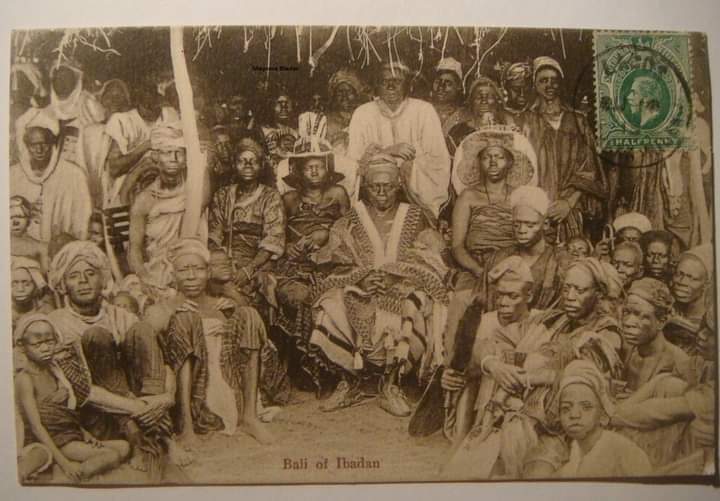
Photo: “Bale of Ibadan, Southern Nigeria ,1913”
In the 19th century, Yorubaland faced insecurity due to intra-Yoruba wars and the Sokoto Sultanate’s military Jihad. This led to mass migrations within Yorubaland, resulting in the disappearance of old cities like Old-Oyo and Owu, while new fortified towns such as New Oyo, Abéokuta, and Ibadan emerged. Ibadan, established in 1829 as a war camp, strategically located with hills offering defense advantages, evolved into a military state and later expanded its empire over northern and eastern Yorubaland. Despite its military character, Ibadan’s economy relied on agriculture, manufacturing, and trade. During the colonial period, Ibadan’s position strengthened within the Yoruba urban network, particularly with the cocoa boom attracting European and Levantine firms and traders from various parts of Nigeria.
BAALE OF IBADAN UNDER COLONIAL RULE (1893 – 1960)
1) Fijabi became Baale – (1893 – 1895)
2.) Osuntoki was Baale – (1895 – 1897)
3.) Fajimi was installed Baale of Ibadan but in 1899 acquired the title of
Basorun from Alaafin of Oyo, Oba Adeyemi Alowolodu I.
Note (i): Capt. F.C. Fuller inaugurated the first Ibadan Town Council
in 1897
(ii): He formally recognized the composition of Ibadan Traditional
Council.
4.) Baale Mosaderin – (1902 – 1904)
5.) Baale Dada Opadare (1904 – 1907)
6.) Basorun Apanpa (1907 – 1910)
7) Baale Akintayo Elempe (1910 – 1912)
8.) Baale Irefin Ogundeyi (1912 – 1914)
9) Baale situ (Omo Aare) (1914 – 1925)
10) Baale Oyewole Foko (1925 – 1929)
11) Baale Abass Okunola (1930 – 1935).
Note: For a period of 100 years of the existence of the Ibadan (1825 –
1925).
There were 24 Baales with varying acquired titles as Basorun, Aare – Ona –
Kakanfo and Generalissmo.
Text: Legacy of Baale Irefin Ogundeyi
About The Author


