
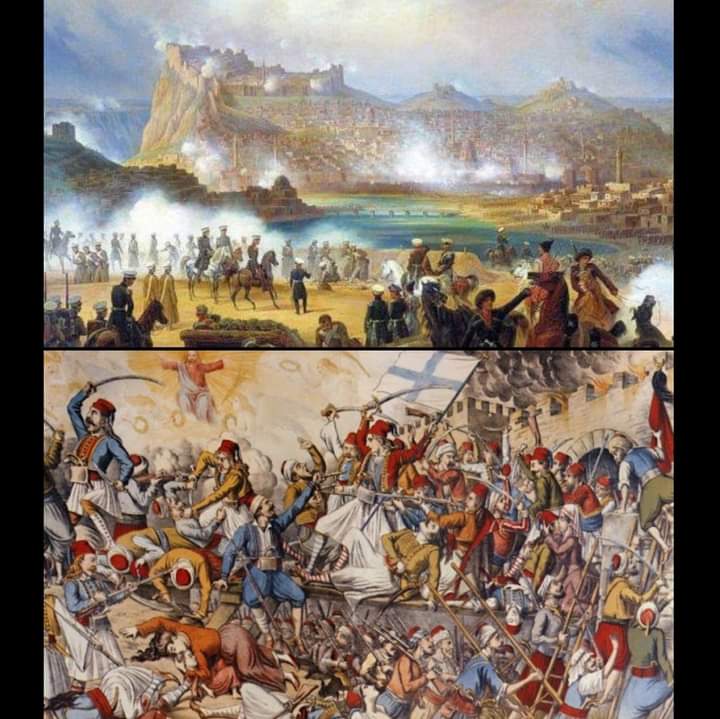
February 1770 – The Greek Revolution (Orlov Revolt)
February 254 years ago, saw a Greek Revolution, one of the last major Greek independence attempts, before the campaign of 1821.
Notable Greeks of this Revolution were: Panagiotis Benakis, Ioannis Vlachos (Daskalogiannis), Konstantinos Kolokotronis, Lambros Katsonis, the Metropolitans of Patra, Corinth, Sparta, Argos, Tripoli and Georgios Papazolis, originally from Siatista in Macedonia and who was at the time, a Captain in the Russian Army.
The Revolution took place within the backdrop of the Russo-Turk War (1868-74). Russian representatives, mainly in the form of the Orlov brothers, laid the groundwork, establishing contacts & making pacts with Greek armed groups, leaders and fighters. Using the shared Orthodox Christian faith as a carrot to entice the Greeks to revolt.
Russia’s plan involved a two-fold approach, to weaken and deal a blow to the Ottoman Empire, especially with their fleet in the Aegean and to create a distraction, diverting Ottoman soldiers and supplies away from the main theatre of the war, which was in Crimea and in and around the Black Sea.
Mani in the Peloponnese would be the base for the Greek Revolution, which spread to Sterea Ellada, Thessaly, Epirus and Crete.
The Russians promised a significant Russian navy fleet, 10,000 men, aid, supplies and significant weaponry to assist the Greeks. But the operation from Moscow, only involved a few ships and a few hundred men, the inadequate support greatly disappointed the Greeks.
After some initial victories in southern Peloponnese, the Greek forces were greatly outnumbered and were over-run by the Turk-Albanians. Greek re-enforcements from Macedonia and Thrace were stalled on their travels south and were denied passage southwards to assist their fellow Greeks.
The Revolution was put down everywhere by the Ottomans. Many Greek leaders were killed, with Turk-Albanian mercenaries also being unleashed by the Ottomans in the Peloponnese, where they wreaked havoc on the Greek population. Massacring, raping, looting, with thousands of Greeks sold into slavery to the Turks and to Africa.
For Russia, the whole endeavour was a huge success for them in terms of their goals, earning significant naval victories particularly in the Aegean, off the west coast of Anatolia, with help from Greek islanders. The Russians acquired much territory and received major concessions from the Ottomans in the aftermath.
From the Greek point of view, it was a failure which cost a huge number of lives, both in battle and in the Turk-Albanian reprisals that followed. The Greeks received virtually nothing for their efforts and they became increasingly disillusioned with the Russians as a result.
The distrust as a result of the disastrous outcome, meant that many Greeks now viewed the Russians with suspicion and would increasingly look to and turn to the French and the British in the future.
About The Author


