
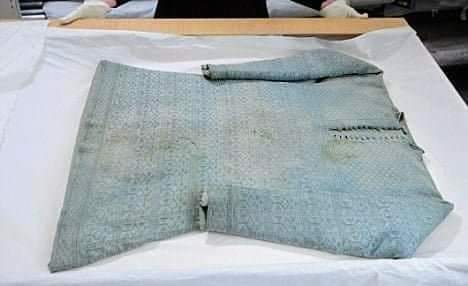
Dressed for Death…The garment allegedly worn by Charles I for his execution
Historians are hoping to use modern DNA testing to finally crack the mystery of what Charles I was wearing, when he was bEheaded at The Banqueting House on 30th January 1649.
Charles is said to have worn two shirts for his final hours, on account of the bitterly cold weather in London.
Experts have long believed that a stunning light blue knitted silk waistcoat was, at least, the over-garment.
They are hoping to prove that undated stains on the waistcoat, visible only under ultraviolet lights, are blood splashes left from the public killing of the former king.
Primitive tests run in 1959 and 1989 by the Metropolitan police Forensic Society were only able to confirm the stains were bodily fluids.
After the exEcution, the King’s body was removed and buried in Henry VIII’s tomb in Windsor Castle – without any religious service.
His corpse was undressed and his clothing distributed to people at the exEcution, including Charles’ physician, who allegedly obtained the waistcoat.
One of the most striking features of the garments is the lack of any heavy staining that perhaps would have been expected, after being worn during a b-heading – especially around the collar.
The arterial blood released after decapitation would have spurted forward with considerable force.
With a linen shirt underneath, which may have soaked up any blood near the neck, it is possible that no blood got onto the waistcoat during the bEheading.
If the stains are blood, they could have been incurred during handling after his death.
The waistcoat has been the Museum of London’s ‘number one’ artefact since its donation in 1925.
Hilary Davidson, Curator of Fashion and Decorative Art, said:
‘If the new tests are able to conclude it’s blood then there will be little doubt left.
It’s nearly impossible to prove 100% that this is Charles’ exEcution waistcoat, but there are several important pieces of evidence suggesting it was.
All we can do is try to build on the evidence we have and use new techniques to seek out new information.
We have a provenance that came with the coat with dates that exactly match the history we know.
There are also paintings showing Charles wearing a similar coloured garment that matches the style and several written accounts of him wearing a silk blue waistcoat.
The quality is also expensive and luxurious enough to be royal”
A convincing note of authentication detailing its owners since the exEcution, was attached to the item during a private sale following Charles’ death.
It told how it came into the hands of Charles’ private physician who attended the bEheading.
It read:
“This Waistcoat was worn by King Charles the First on the day he was b-headed and from the scaffold came into the Hands of Doctor Hobbs his Physician who attended him on that Occasion.
The Doctor preserved this Relic of his Royal Master, and from him it Came into the Possession of Susannah Hobbs his Daughter, who married Temple Stanger of Rawlins in the County of Oxfordshire.
The above account of this Waistcoat was taken from the Testimony of Dame Grace Stanger, Second Wife and Relict of the above mentioned Temple Stanger in the year 1767.”
The waistcoat was subsequently owned by relatives of Temple Hardy until 1898, when it was sold at auction by the last of the family line.
The waistcoat achieved a sale price of 200 guineas (£210), ‘not an exorbitant price’, one writer thought at the time, for ‘a relic at once authentic and ghastly’.
It changed hands again in 1910, for the same price.
Mr and Mrs ES Makower purchased the garment in 1925 for presentation to the Museum of London, where it has been kept ever since.
About The Author


