
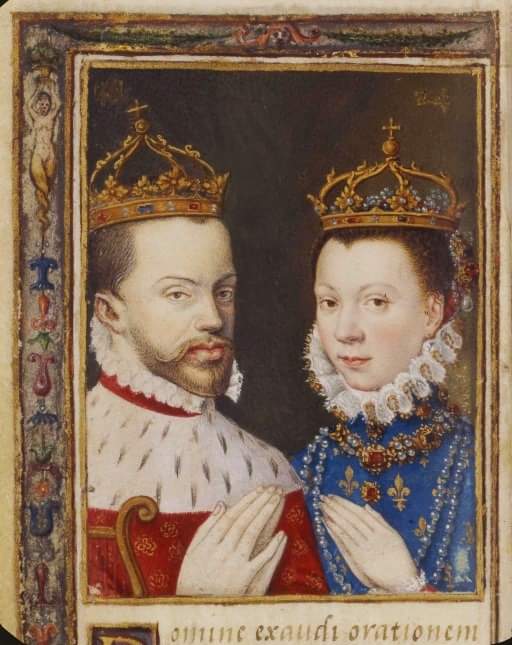
Philip II of Spain Marries Elisabeth de Valois
Elisabeth de Valois (called Isabel in Spain) was born on 2nd April 1545, at the royal palace of Fontainebleau.
She was the second child of King Henri II, then the Duc d’Orléans and his wife Catherine de’Medici.
In November 1547, a new baby sister Claude joined the household.
The following year, Mary Queen of Scots came to live with the princesses, after she was betrothed to Elisabeth’s elder brother, the Dauphin François.
At the age of ten, Elisabeth joined her Mother’s court.
She was her mother’s favorite, and both her parents were extremely proud of her.
Elisabeth was described as having a round face with an olive complexion, large dark brown eyes, long nearly-black finely textured hair, a delicate and well-proportioned slim figure with a small waist.
Elisabeth was graceful, had exquisite manners, and she enjoyed spending time in her mother’s company.
Elisabeth made her first state appearance, at the marriage of her elder brother François to Mary Queen of Scots on 24th April 1558.
In November 1558, Philip of Spain’s second wife Mary Tudor, Queen of England died, leaving him single again.
Philip began to put himself forward, as a husband for Elisabeth.
With Elisabeth’s father providing a dowry of four hundred thousand gold crowns, a marriage agreement was drawn up.
On 28th June 1559, Elisabeth attended a massive tournament, with her father King Henri, participating.
During the king’s run through the lists, he was mortally wounded by his opponent, when a wooden lance went through his visor and splintered in his eye and head.
King Henri experienced extreme agony for days and died of his injuries on 10th July 1559.
Elisabeth attended the coronation of her brother Francois, at Reims Cathedral.
She then made a slow journey to Spain, to join her new Husband.
Elisabeth arrived in the city, and made a grand entry on horseback, impressing everyone with her beauty.
The official wedding ceremony took place on 31st January 1560.
Elisabeth was magnificently dressed, adorned with many jewels and she wore an imperial crown.
In Spain, Elisabeth attempted to recreate the atmosphere and gaiety, of the Renaissance court of France.
She loved parties, plays, masked balls, and outings to her palaces, spectacles and picnics.
Still a teenager, she was lazy and self-indulgent.
She rose and went to bed at erratic hours, and ate whenever she felt like eating.
She bought three harps, an organ and many viols and flutes, and paid for a dancing master.
She loved to gamble, and played board games and cards, threw dice every day, sometimes borrowing from her servants so she could continue to play and lose.
She loved to buy clothes.
She would pay, to have plays performed for her entertainment.
One afternoon’s performance, at Easter in 1565, may have cost as much as fifty-thousand ducats.
Elisabeth’s husband Philip, tolerated the frivolity and spending.
The marriage wasn’t consummated until January 1562, and Philip slept with her regularly after this.
In public, Philip always showed her honor and affection.
But in reality, Elisabeth gave Philip little satisfaction.
When Philip returned from a nine month long trip to Aragon, relations between the couple improved greatly.
Elisabeth became pregnant.
Along with the usual symptoms, Elisabeth began to suffer from headaches, nausea and fainting.
Sadly, Elizabeth was very sick for three weeks, and lost the baby.
Philip spent time at her bedside while she was ill, holding her hand.
Despite his fondness, Philip could not be faithful to Elisabeth, but they seemed to enjoy domestic happiness.
Elisabeth became pregnant again, and Philip began spending two hours a day with her, showering her with great affection.
He was at her side when she gave birth to Infanta Isabella Clara Eugenia on 12th August 1566.
In early 1567, Elisabeth was pregnant again.
She gave birth to Catalina Michelle on 10th October 1567.
Philip showed great disappointment at the birth of another girl, and did not attend the child’s baptism.
Elisabeth loved her two daughters very much, and spent as much time as she could with them.
Elisabeth became pregnant again, soon after Catalina’s birth.
She spent her pregnancy relaxing, playing cards, quoits and throwing dice, enjoying jokes from her fools, and watching plays.
Everything seemed to be going well, until September of 1568, when she became ill, gaining a lot of weight.
She was fainting frequently, having trembling fits, and had weakness and numbness on her left side.
She couldn’t sleep and was unable to eat.
On 3rd October 1568, Elisabeth and Philip heard Mass together.
Elisabeth prayed that Philip would have a long life, and promised she would pray for him again, when she got to heaven.
A few hours later, Elisabeth gave birth to a girl.
Several hours later, both Elisabeth and her daughter were dead.
Elisabeth was only 23 years old.
A memorial service was held for Elisabeth on 24th October 1568, at the French court.
She was buried along with her infant daughter in the Convent of Las Descalzas Reales in Madrid.
Philip went into seclusion to mourn, and refused to look at papers for over two weeks.
On 7th June 1573, the remains of Elisabeth were transported from Madrid, to the new basilica at El Escorial, and were buried in a vault, near the high altar of the convent chapel.
In 1654, Philip’s descendant King Philip IV, completed the Pantheon of Kings in the Royal Crypt of the Monastery of El Escorial.
Elisabeth’s remains were once again transported, and re-interred there.
Philip married his fourth and final wife in 1570.
She was his niece, Anna of Austria.
This marriage produced four sons and one daughter.
Anna died of heart failure 8 months after giving birth to a daughter Maria, in 1580.
Philip II died in El Escorial, near Madrid, on 13th September 1598, of cancer.
He was succeeded by his 20-year-old son, Philip III.
Elisabeth de Valois with her husband, Philip II of Spain
About The Author


