
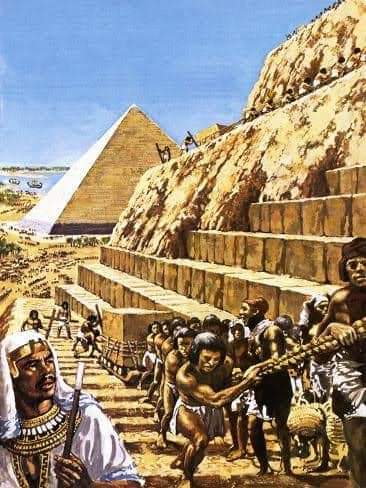
The pyramids were built by slaves
What you may have been told
The great pyramids in Egypt were built by slaves; it even says so in the Bible.
The debunking
We all know the image: slaves dragging huge stones up ramps while a master whips them; but the scene is mostly fantasy. Yes, there were slaves in ancient Egypt and somewhere along the production line they were very likely involved in the building of the pyramids – after all, slavery was part of daily life. So I don’t think we can say they had absolutely nothing to do with the construction of the pyramids, but there is no evidence that they actually built them.
And no, it is not mentioned in the Bible either.
The book of Exodus does mention that Hebrew slaves were forced to work
‘in mortar and brick’ but it doesn’t specify that these were used for pyramids:
And the Egyptians were in dread of the people of Israel. So they ruthlessly made the people of Israel work as slaves and made their lives bitter with hard service, in mortar and brick, and in all kinds of work in the field In all their work they ruthlessly made them work as slaves.
The myth was probably born because someone misunderstood what Herodotus, the ancient Greek historian known as both the Father of History’ and Father of Lies’, wrote in his Histories (in 430 BC, long after the fact) about the pyramids:
To some, (the king) assigned the task of dragging stones from the quarries in the Arabian mountains to the Nile; and after the stones were ferried across the river in boats, he organised others to receive and drag them to the mountains called Libyan. They worked in gangs of a hundred thousand men, each gang for three months. For ten years the people wore themselves out building the road over which the stones were dragged, work which was in my opinion not much lighter at all than the building of the pyramid.
Somewhere along the line someone added one and one and ended up with three. And then Hollywood got involved and the image of a shirtless Charlton Heston asking Pharaoh Yul Brenner to let his people go embedded itself in the general consciousness.
It wasn’t until relatively recently that historians and archaeologists started to find evidence that clashed with the long-accepted story. Historians started to wonder where the people who worked on the pyramids lived; building them would have required thousands of labourers who all had to live somewhere.
Near the pyramids, they found the workers’ city. As expected, it was huge, but it didn’t look like a place where you’d keep slaves! Along well-made streets there were large dormitory like houses surrounded with evidence of fish preparation, cattle being butchered and bread being baked on a huge scale. These workers enjoyed a good diet of high-quality food – luxurious even, the kinds of meals that wouldn’t be wasted on common slaves that had been whipped and worked to the bone all day. That would just be silly.
In one papyrus letter, an expedition leader complains about how it’s going to take too much time to provide his workmen with clothes. So the labourers were given good housing, great food and clothing. This shows that the men were looked after very well but it may also mean they received all this as payment for their work.
Slaves don’t get paid.
The archaeologists found graffiti on some of the buildings, including the names of some of the workers’ crews. One called their group ‘the drunkards of Menkaure’, who sound like they were a fun bunch. Does that sound like something slaves would do? Give their gang a funny name? Would slaves even be able to become drunkards on their likely meagre rations?
They also found the remains of some of these builders in a special cemetery near the ruins of the city and very close to the tombs of the pharaohs. If you were a rich, powerful person, a demi-god, would you want your slaves to spend eternity near you? I wouldn’t. Their ghosts can stay out of sight and float to work every day. Their proximity to the pharaohs was a sign of respect, something not afforded to the average person. The human remains showed signs of arthritis, damage and wear on their spines; the work was evidently tough and demanding. This makes it tempting to assume they were forced to do this work, but there are many reasons people will do hard, punishing work.
Some of the skeletons actually showed evidence of medical treatment: damaged hands and legs that were operated on. Someone had cared for them for days, perhaps weeks or even longer, while they couldn’t work. Which, again, is something people probably would not have bothered with if these workers had been ordinary slaves. Some of the labourers may have been working in order to pay their taxes, which is a little less voluntary, but still not slavery.
But why would they have done this dangerous and very demanding hard work if they weren’t forced to? Besides being paid, spoiled and perhaps paying their taxes by doing this work, they may have also considered it an honour to work on such important buildings, and believed they would be rewarded in the arterlife. It was, of course, also a steady job – building a pyramid took decades! Besides, people have been risking their health for work throughout history. Those who worked on the European medieval cathedrals risked their lives, but they were not slaves.
Victorian mineworkers destroyed their lungs to make a living, but they were not slaves. And today many of us ruin our backs by sitting in front of a computer screen from nine to five and we’re not slaves either – well, not technically, anyway. We may not always have much of a choice, but we still get paid and aren’t someone’s property.
So, in conclusion, there is a lot of evidence that shows the pyramids were built by well-looked-after labourers, and no evidence at all that they were built by slaves. Oh, and the pyramids were also not built by aliens, just so you know.
Source ~ ‘Fake History 101 things that never happened’ by Jo Hedwig Teeuwisse
About The Author


