
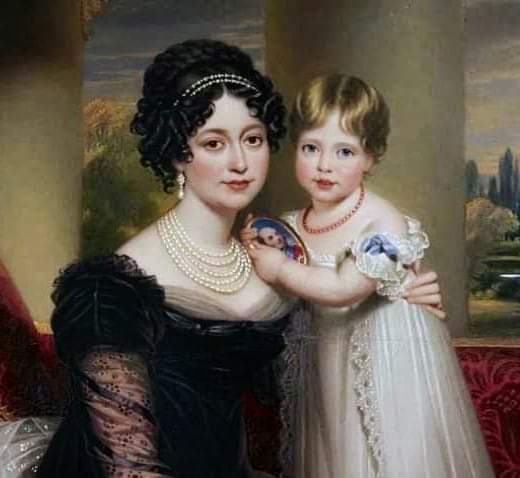
Victoria was born in Coburg, on 17th August 1786.
She was the fourth daughter, and seventh child of Franz Frederick Anton, Duke of Saxe Coburg-Saalfeld and Countess Augusta of Reuss-Ebersdorf.
On 21st December 1803, Victoria married her first husband, Charles, Prince of Leiningen.
The couple had two children, Prince Carl and Princess Feodora of Leiningen.
Charles died in 1814, and Victoria served as regent of the Principality of Leiningen, for their son, Carl.
Victoria’s brother Leopold, was married to Princess Charlotte, heir to the British throne.
When Charlotte died in 1817, a succession crisis arose.
Three of Charlotte’s uncles, the sons of George III, needed to marry.
Prince Edward-Duke of Kent and Strathearn, the fourth son of George III, proposed to Victoria and she accepted.
The couple were married on 29th May 1818, and Victoria became the Duchess of Kent and Strathearn.
Soon after the couple moved to Germany, Victoria became pregnant.
The Duke and Duchess, were determined to have their child born in England.
They moved into Kensington Palace, where Victoria gave birth to a daughter on 24th May 1819.
She was named, Princess Alexandrina Victoria of Kent, and would become the future, Queen Victoria.
Duchess Victoria’s husband Edward, died suddenly of pneumonia, in January 1820 – six days before his father, King George III.
Of the three brothers older than Edward, the new king, George IV, and the Duke of York, were estranged from their wives, who were past childbearing age.
The third brother, the Duke of Clarence, had yet to produce any surviving children, with his wife.
After the death of Edward and his father, the young Princess Victoria, was now third in line for the throne.
In 1831, with George IV dead and the new king William IV being over 60 without any surviving legitimate issue, the young princess Victoria now became Heir presumptive.
Duchess Victoria was extremely protective, and raised the young Victoria largely isolated from other children, under the so-called “Kensington System”.
The system prevented the princess from meeting people whom her mother and Conroy (The Duchess’ private secretary) deemed undesirable – including most of her father’s family.
The system was designed to render her weak, and dependent upon them.
Conroy monitored the Princess’ every move, and he was a big part of why Victoria was almost completely cut off from the rest of the royal family.
Duchess Victoria avoided the court, because she was scandalised by the presence of King William’s illegitimate children.
She insisted that her daughter avoid any person’s of sexual impropriety.
She would insist on always sharing a bedroom with her daughter every night, made sure she studied with private tutors to a regular timetable, and only allowed her to spend her play-hours with her dolls, and her King Charles Spaniel, Dash.
Both the King and Queen Adelaide, were fond of their niece, young Victoria, but their attempts to forge a close relationship with the girl, were frustrated by constant conflicts with her mother.
The breach between the Duchess Victoria and the King and Queen was never fully healed, but Victoria always viewed both of them with kindness.
King William expressed his hope that he would survive until Princess Victoria was 18, so that Duchess Victoria, or her evil supporter, Conroy would never be regent.
As the personal secretary of the Duchess, Conroy would be the veritable “power behind the throne”.
He had not counted on William IV surviving long enough, however, for Victoria to come of age, and be able to succeed to the throne as an adult.
When Victoria came to the throne, aged 18, Conroy tried to force Victoria to agree to make him her personal secretary.
Victoria resented her mother’s support for Conroy’s schemes, and the constant pressure by her, to sign a paper declaring Conroy her personal secretary.
Victoria relegated her mother to separate accommodations, away from her own.
When the Queen’s first child was born, Duchess Victoria unexpectedly found herself welcomed back into her daughter’s inner circle.
Conroy by now, lived in exile on the Continent, and so his divisive influence was removed.
The Duchess’s finances, which had been left in shambles by Conroy, were restored, thanks to Victoria and her advisors.
By all accounts, the Duchess became a doting grandmother and was closer to her daughter than she ever had been.
Duchess Victoria died at 09:30am on 16 March 1861, aged 74 years, with her daughter Victoria at her side.
The Queen was much affected by her mother’s death.
Through reading her mother’s papers, Victoria discovered that her mother had loved her deeply.
She was heart-broken, and blamed Conroy for “wickedly” estranging her from her mother.
The duchess is buried in the Duchess of Kent Mausoleum at Frogmore, Windsor Home Park – near to the royal residence Windsor Castle.
The duchess of Kent with her daughter, the future queen Victoria ~ Henry Bone (c. 1824/25)
About The Author


