
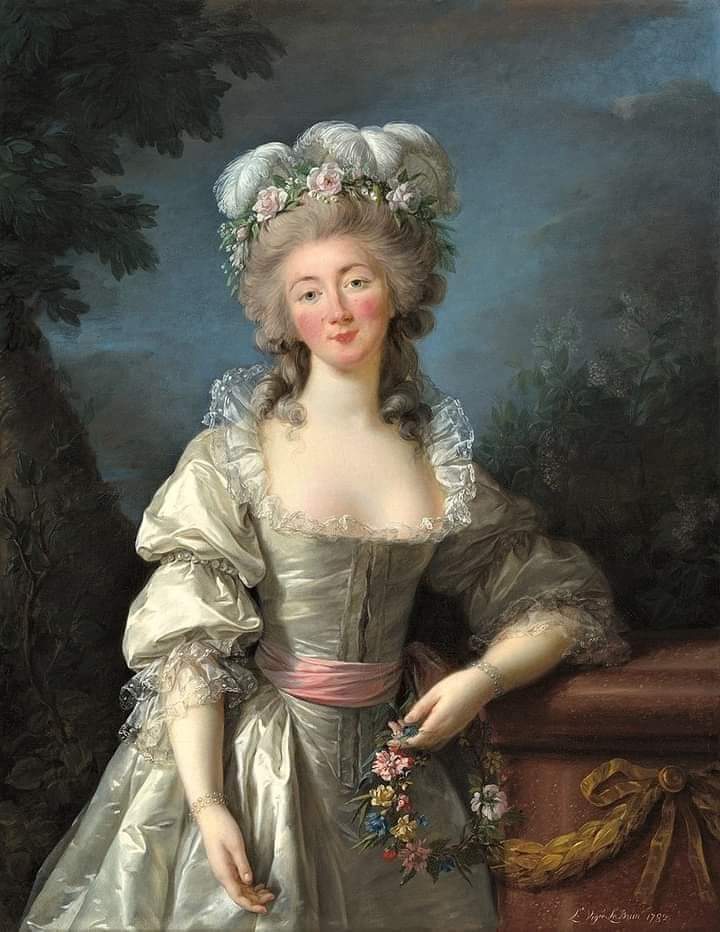
Jeanne Bécu – Comtesse du Barry, becomes King Louis XV’s “official” Maitresse-en-titre
Jeanne Bécu, Comtesse du Barry, was the last Maitresse-en-titre (Chief Royal Mistress) of Louis XV of France.
She was also one of the victims of the ‘Reign of Terror’ during the French Revolution.
Jeanne Bécu was born at Vaucouleurs, France, as the illegitimate daughter of Anne Bécu, a seamtress, on 19th August 1743.
From a young age, Jeanne was educated at a Convent, but when she turned 15, Jeanne had to find some sort of income to help herself live.
She travelled the dingy streets of Paris, carrying a box of trinkets for sale.
Jeanne was a remarkably attractive blonde woman, with thick golden ringlets and almond-shaped blue eyes.
Her beauty came to the attention of Jean-Baptiste du Barry, who was a high-class pimp/procurer of females for men.
Du Barry installed her in his household, and made her his mistress.
Du Barry helped establish Jeanne’s career as a courtesan in the highest circles of Parisian society.
This enabled her to take several aristocratic men, even courtiers, as brief lovers or clients.
Jeanne immediately became a sensation in Paris, building up a large aristocratic clientele.
She had many lovers from the king’s ministers to his courtiers.
King Louis XV took a great interest in her, and had her escorted to the royal boudoir frequently.
The King was totally enthralled, and kept her close at all times.
Jeanne could not qualify as a Chief Mistress, unless she had a title.
The king ordered that Jeanne be wedded to a man of strong lineage, so she may be brought to court as per protocol.
On 1st September 1768, Jeanne was married to Comte Guillaume du Barry.
The marriage ceremony included a false birth certificate, which gave her a fictitious noble descent.
Jeanne was now installed above the King’s quarters, in sumptuous apartments.
She lived a lonely life, unable to be seen with the King since no formal ‘presentation’ had taken place yet.
Very few, if any, of the nobility at court deigned to become acquainted with her, for none could accept the fact that a woman of the street, had the audacity to mingle with those above her station.
Finally, Jeanne was presented to the Court as Maitresse-en-titre, at Versailles, on 22nd April 1769.
Jeanne was wearing a queenly, silvery white gown, brocaded with gold, bedecked in jewels sent by the king the night before, and with huge panniers at the sides, Jeanne made quite an entrance.
The dress had been specifically ordered for Jeanne.
Her hairdo was also, noticeably spectacular.
Jeanne’s everyday routine began at 9am, with a morning cup of chocolate.
Later she would be dressed in a fine gown of choice, and dressed in her jewellery.
Then her hair was dressed either for everyday, or for special occasions.
Her hairdresser would come to her, and do her hair in powders and curls.
She would then receive friends, dressmakers, jewellers and artists, showing off their new stock hoping she would be interested in buying something from them.
She was indeed extravagant, but her good nature was not spoiled.
Jeanne’s relationship with Marie Antoinette, however, was contentious.
They first met the day before Marie’s wedding to the Dauphin.
Jeanne had only been official mistress a little over a year, and many thought she would not be included in the list of guests for the occasion.
It ended up being otherwise, to the disgust of most of those present.
Marie Antoinette noticed Jeanne, who stood out from the rest of the crowd with her attractive extravagant appearance.
When Marie found out about Jeanne’s scandalous past, she defied court protocol, by refusing to speak to Jeanne.
Jeanne furiously complained to the king, who in turn did his best in convincing Marie Antoinette to ease her ways.
Eventually, during a ball on New Years Day 1772, Marie Antoinette spoke indirectly Jeanne, by casually observing ~
“There are many people at Versailles today,”
In 1772, the infatuated Louis XV, requested that Parisian jewellers Boehmer and Bassenge, create an elaborate and spectacular jeweled necklace for Jeanne.
It would be one that would surpass all known others in grandeur, at an estimated cost of two million livres.
Knowing that she loved diamonds, and that her tastes verged on the vulgar, the royal jewelers Boehmer and Bassenge began to assemble diamonds for an enormous necklace named the Slave Collar.
The necklace, was still not completed, or paid for, when Louis XV died – although it would go on to spark a rumour that would change many lives.
Marie Antoinette was accused of bribing the Cardinal, to purchase the necklace for her……accusations which would figure prominently in the onset of the French Revolution.
Following the death of Louis XV, and his grandson’s ascension to the throne, Marie Antoinette had her husband exile Jeanne to the Abbey de Pont-aux-Dames.
At first she was not met warmly by the nuns, who knew that in their midst, they had the thirty-one-year-old former royal mistress.
Soon enough they grew accustomed to her timid ways, and warmed up to her.
After a year at the convent, Jeanne was granted permission to visit the surrounding countryside, on the condition she returned by sundown.
A month later, she was given permission to leave the abbey, but not to venture closer than ten miles towards Versailles.
She then managed to purchase property.
In 1792, the Revoluntionary Tribunal of Paris accused Jeanne of treason, and condemned her to death.
Suspected of financially assisting the aristocratic émigrés who had fled the Revolution, she vainly attempted to save herself by revealing the location of gems she had hidden.
On 8th December 1793, Jeanne was b-headed by the guillotine on the Place de la Revolution, now known as the Place de la Concorde.
On the way to the guillotine, she collapsed and cried ~
“You are going to hurt me! Why?!”
Terrified, she screamed for mercy, and begged the watching crowd for help.
Her last words to the exEcutioner are said to have been ~
“De grâce, monsieur le bourreau, encore un petit
moment!” –
“One more moment, Mr. ExEcutioner, I beg you!”
Jeanne was buried in the Madeline Cemetery, like many others exEcuted during the Reign of Terror—including Louis XVI and Marie Antoinette.
🥀 Jeanne Bécu – Comtesse du Barry c.1782
Portrait by Élisabeth Vigée Le Brun.
About The Author


