
Igbo Kings: Eze or Igwe or Obi?
To me, the correct word for a king in Igbo is Eze. We are not here to argue if Eze means king or priest. Our focus is on the use of Igwe and Eze to refer to Igbo kings.
Yes, we are all aware that both Eze, Igwe, and Obi can mean the same thing now, but Igwe is more popular in some parts of Enugu state and some parts of Anambra state, while Eze is more popular in Abia, Imo, Ebonyi, Benue parts of Igbo, and Rivers parts of Igbo. While Obi is popular in Igbo parts of Delta and Onitsha people.
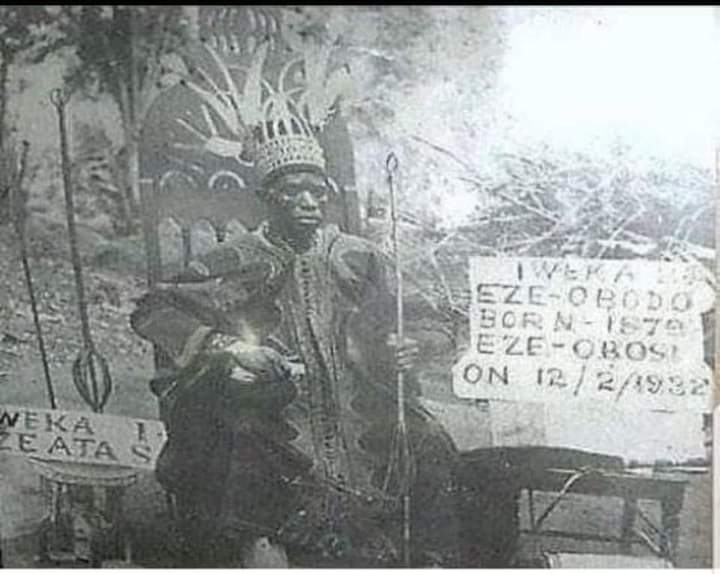
Funny enough, the King of Nri (in Anambra state) was historically referred to as Eze Nri. Igwe is only more popular in Nollywood movies. Eze Israel Eloebo Iweka (1879-1934), Eze ndi Obosi, was made the first king of Obosi in 1932. But today, kings in Obosi are being referred to as Igwe. This is an indication that the original name for king in Igbo is Eze. As we also know, Nri, who had their king around the 15th century, called their king Eze.
The honest truth is that the title “Igwe” has commonly been interpreted as “King,” but it actually means “heaven” or “heavenly.” It was used as a form of salutation to imply “your highness.” The title was adopted in the early 1900s by warrant chiefs in the Anambra/Enugu axis. However, the Igwe title originated as a salutation for kings (Obi) among Oru communities and Western Igbo communities who had well-structured monarchies. In towns like Ase, it was the title of the king himself. The cult of Igwe (the sky god) was prominent among Oru clans.
The kings in Onitsha, Oru, and Western Igbo were viewed as divine beings, demigod sons of heaven, and Igwe was a salutation of that status. Traditionally, kingship was maintained in one lineage in many of the towns, and consequently, even members of the royal family, such as the princes (Umudei), were saluted as Igwe as well.
Early documentation shows that town chiefs in the Eastern Igbo hinterland were referred to as Eze (chief priest). Most of Igbo society was basically a theocracy ruled by Eze, who were chief priests or, as some would put it, priest-kings. These were not typical kingdoms but republican societies in which the Eze was the consensus holder.
The introduction of the warrant chief system was modeled after the British monarchical system, which didn’t fit in the society because many of them didn’t have traditional legitimacy or the offor of the priesthood. The earliest documents referred to the traditional rulers of places like Obosi, Nri, Aguleri, Aguata, Eke, and Udi as Eze.
The Igwe title became increasingly adopted by the warrant chiefs in the 1950s when the issue of traditional rulership in the East became political. Today, it has been greatly bastardized, and in some villages, one has to buy a form to contest for the seat.
That’s why you see any Igbo proverbs or idioms with the term igwe but Eze. You can’t hear “Igwe ndi Igbo” in Turkey, China, Lagos, etc. Rather, they are called “Eze ndi Igbo” in China, Lagos, and Turkey, etc., and “Ohaneze Ndígbo.
In the picture below is Eze Iweka of Obosi.
About The Author


