
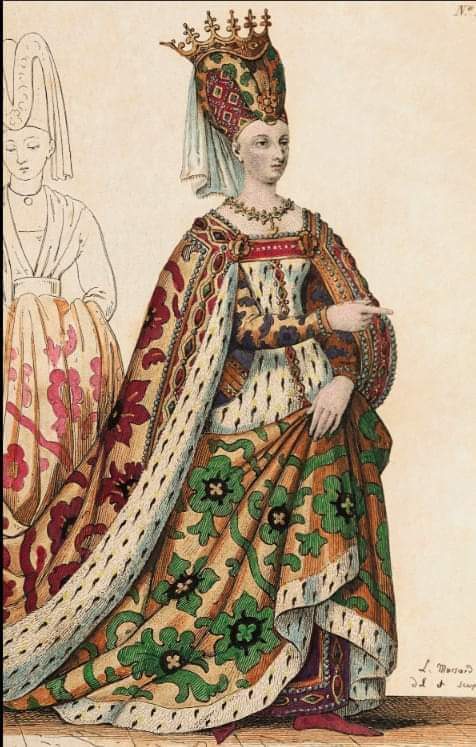
Isabeau of Bavaria
Isabeau of Bavaria, was Queen of France from 1385 to 1422.
She was married to the French King, Charles VI, and ruled as Regent when Charles succumbed to his bouts of madness.
Seductive, cunning, and dangerous, Isabeau was a powerful queen, in an age of obedient women.
She allowed no man, not even her own unhinged husband, to control her.
Because of the absolute turmoil in her life, Queen Isabeau, has gone down as one of the greatest villainesses in history.
By the end of her reign, so much scandal, revenge, and death had happened around her, people even whispered that she was actually a sorceress.
From an early age, it was clear to anyone who saw her, that Isabeau was going to be beautiful.
She had inherited her mother’s dark “Italian” features, which gave her a mesmerizing beauty, in an era that preferred blondes.
Isabeau quickly learned to use her femme fatale looks, to their full effect.
Isabeau adored putting on enormous displays of wealth, which didn’t make her popular among the French people.
She wore dresses dripping in gems, coiled their hair into massive braids, and wore hats so big the palace had to renovate doorways to allow her through them!
Isabeau had six sons and six daughters.
The first son, born in 1386, died as an infant, her last son Philip, born in 1407, lived a single day.
Three other sons also died young, with only her youngest son, Charles VII, living to adulthood.
Five of her six daughters survived.
Four were married and one, Marie, was sent at age four to be raised in a convent, where she became the prioress.
Isabeau was a fierce tiger mother, and she would do absolutely anything, to protect her sons and daughters.
She insisted her children always travelled with her, and even more unusually for the time, demanded that her sons live in her household.
When she was away, she frequently bought them gifts and continually wrote them letters.
To many of her enemies at court, Isabeau was a luxuriating and extravagant woman.
One source claims she only had so many pregnancies, because she loved the gifts that came with expecting a new heir to the throne.
Another source depicts her living “on the delights of the flesh.”
In 1392, King Charles suffered the first attack of what was to become a lifelong and progressive mental illness.
On a hot August day, he attacked his household knights, including his brother, killing four men.
After the attack he fell into a coma that lasted for four days.
After the onset of the King’s illness, a common belief was that his mental illness and inability to rule, were due to Isabeau’s witchcraft.
Rumors spread that the court was rife with sorcery.
Isabeau was understandably upset that her husband went insane, and her reaction wasn’t received well.
The queen removed herself from the royal palace during the worst of her husband’s illnesses, attracting bitter criticism from the court.
They accused her of abandoning her king.
Charles decided to make Isabeau the official guardian of their son and heir, the Dauphin.
He also allowed her to negotiate peace treaties, and take control of the court.
However, all this power put a terrifying target on Isabeau’s back.
Suddenly, 22 year old Isabeau went from hot trophy wife, to one of the only people who could hold Charles’s reign together.
Isabeau’s influence grew in court, and her enemies grew along with it.
She sat on the regency council, allowing far more power than was usual for a medieval queen.
Isabeau was a talented diplomat, who navigated court politics with ease, using her cunning, grace and charisma.
As Charles’s madness grew, rumors started to spread that Isabeau had developed a wandering eye…for the worst person imaginable.
According to some sources, she took up with her own brother-in-law Louis, the Duke of Orleans.
Because Louis was King Charles VI’s brother, their relationship was considered incest.
The nobles were repulsed and indignant, and plotted to be rid of Louis.
In 1407, the assassination of Isabeau’s rumored lover, Louis the Duke of Orleans, took place.
According to reports of the time, assailants chopped the Duke into many pieces and left him in a gutter.
Meanwhile, Charles’ bouts of illness worsened, and he would remain this way until his death.
Charles and Isabeau still felt mutual affection.
Although she distanced herself during the prolonged attacks of Charles insanity, Isabeau still felt affection
for her husband.
Isabeau exchanged gifts and letters with him during his periods of lucidity.
Meanwhile, France was in absolute shambles by this time.
Civil conflict raged internally, the country was fighting English forces on its borders – and losing badly.
With little bargaining power and zero eligible heirs left, Charles and Isabeau signed the notorious Treaty of Troyes, which handed over much of France, to the king of England…Henry V.
As part of the treaty, their daughter, Catherine of Valois, was married to Henry V, becoming the Queen of England.
On Henry’s death, Catherine would go on to marry Owen Tudor, starting the Tudor dynasty.
Isabeau’s life is well documented, most likely because Charles’ illness, placed her in an unusual position of power.
Isabeau was often seen as a spendthrift, and an irresponsible philandering adultress.
She was dismissed by historians in the past, as a wanton, weak, and indecisive leader.
She was accused of “incest, moral corruption, treason, luxurious, meddlesome, scheming, and a spendthrift queen.
Modern historians however, now see her as taking an unusually active leadership role for a queen of her time.
A queen forced to take responsibility as a direct result of Charles’ illness
They concluded, that many unflattering elements of her reputation were unearned, stemming from propaganda by her enemies.
After the death of her husband King Charles VI, in 1422, Isabeau wisely retreated from any political meddling.
She lived out the rest of her days in relative peace.
On 24th September 1435, she died, aged 65.
Isabeau was interred next to her husband Charles VI, at The Basilica of Saint-Denis.
? Isabeau of Bavaria – Paul Popper/Popperfoto.
About The Author


