
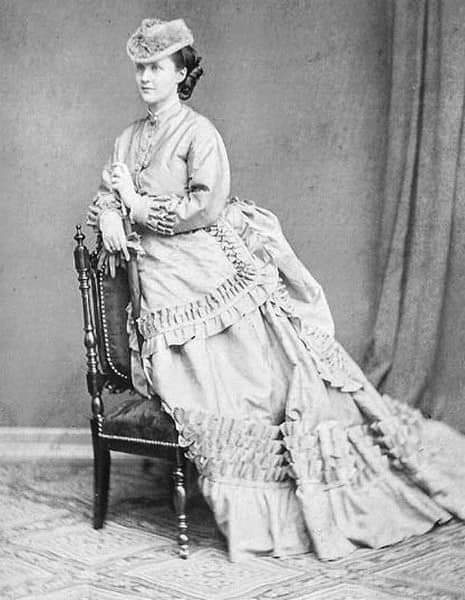
Elisabeth of Wied – the first Queen of Romania
Princess Pauline Elisabeth Ottilie Luise of Wied, the first Queen of Romania, was born on 29th December 1843, at Monrepos castle in Neuwied, Germany.
Her parents were Hermann, Prince of Wied and Princess Marie of Nassau.
As a child, Elisabeth studied French and English literature, philosophy, history, and grammar.
She had an extraordinary talent for languages, including Italian, French, English, Swedish and Russian.
When she was about 16, Elisabeth was considered as a possible bride for Albert Edward, Prince of Wales “Bertie” – the eldest son and heir apparent of Queen Victoria of the United Kingdom.
Queen Victoria strongly favored Elisabeth as a prospective daughter-in-law.
Despite all parties being agreeable to the match, Bertie would instead go on to marry Alexandra of Denmark.
Elisabeth married Prince Carol of Romania in 1869.
One year later their child, Princess Marioara, was born.
Sadly, their joy was short when Marioara died at the age of four years old of scarlet fever.
After her daughter’s loss, Elisabeth’s life would be devoted to the service of her people.
Her work during the War of Independence is well-known.
She was the patron of the Romanian Red Cross and was called by the soldiers “the Mother of Wounded”.
Elisabeth founded schools, charitable organisations and hospitals.
When Romania became a kingdom in 1881, Elisabeth became queen, and she was crowned together with King Carol that same year.
At the Royal Palace in Bucharest, and Peleș Castle
in Sinaia, Elisabeth organized literary and musical soirées.
She welcomed artists such as Pierre Loti, Pablo de Sarasate, Gabrielle-Charlotte Reju, Eleonora Duse and Sarah Bernhardt.
Queen Elisabeth was also a prolific author.
She wrote novels, essays, burlesques, plays, fairy tales and translated Romanian folklore, under the pen-name Carmen Sylva.
Queen Elisabeth understood the huge potential of the Romanian traditional culture.
Amazed by the beauty of the national costume, she used to wear it and promote it at the Royal Court.
Queen Elisabeth encouraged local industry development, and also contributed to the social emancipation of the Romanian women.
Due to the Queen, Romania participated at the Universal Exhibitions organized in Paris, in 1867, 1889 and 1900.
Here, traditional products, embroideries, tapestries and national costumes were exhibited.
As the First World War began to loom, Elisabeth’s husband became sicker and sicker.
Their relationship, by now one perhaps one of reluctant acceptance, had never recovered from the death of their only child.
On 9th October 1914, King Carol died in his sleep, clasped in Elisabeth’s arms.
King Carol was buried in the Curtea de Argeș Cathedral, Romania.
Elisabeth died two years after her husband, on 2nd March 1916, aged 72.
She had been out walking on a cold freezing day, and ended up catching pneumonia.
Her young daughter’s coffin was exhumed and placed on top of Elisabeth’s during the public procession.
They were buried together, next to King Carol in the Curtea de Argeș Cathedral, Romania.
? Queen Elisabeth.
Peleș National Museum.
About The Author


