
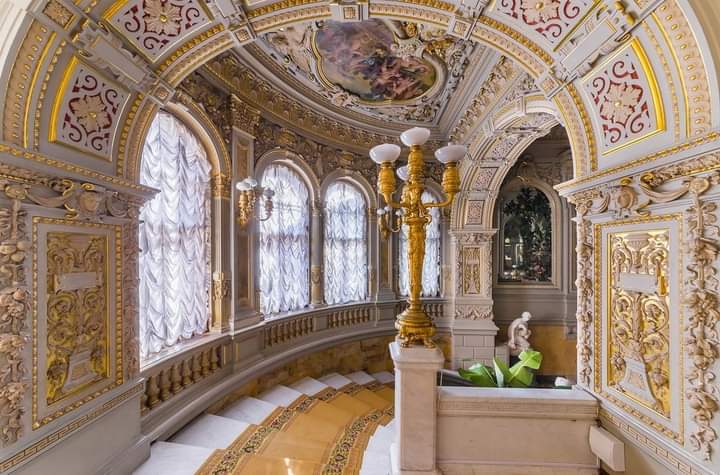
The Vladimir Palace – St. Petersburg Russia
The Vladimir Palace is one of the last regal palaces to be constructed in St. Petersburg.
It was constructed from 1867 to 1872 for Alexander II’s son, Grand Duke Vladimir Alexandrovich of Russia.
The Vladimir Palace reflects a big piece of Russian culture.
It embodies not only the country’s rich history that dates back to the 19th century, but is also linked to many Russian rulers & scientists.
The 360 rooms and outbuildings, feature several design styles – from many different influences.
Neo-Renaissance, Gothic Revival, Russian Revival, Rococo, Byzantine Style, and Louis XIV, are just some of the many influences used throughout the palace.
The exterior facade features stucco rustication, and the main porch has Bremen sandstone that is decorated with griffins, coats-of-arms, and cast-iron lanterns.
One of the largest rooms was a crimson drawing room, which was similar to a living room, designed in the style of the time of Louis XVI.
The Oak Hall is one of the most famous rooms in the palace.
Its walls are decorated with huge paintings.
Each painting portrays a different Russian fairy tale.
There was also electricity, a heating system, and an elevator.
After the October 1917 Revolution, the palace was given to Scientists, and became known as the Academics’ House.
This transfer is probably what enabled the palace to survive the Soviet years without losing any of its original design or detail.
You can still view 19th century porcelain, vases, dinner services, the Main Staircase, the Golden Staircase, the intricate ceiling tiling in the Persian Room, the Monumental Stove in the Oak Hall, and many other stunning displays of design – all in their original forms.
About The Author


